
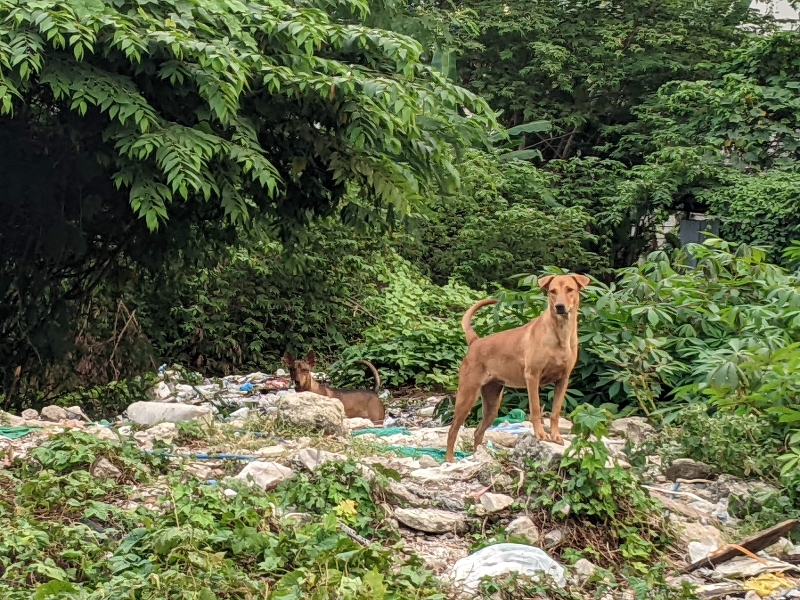

A friend recently cornered me with a deceptively simple question: “What do your days look like when you’re not having an adventure?” I honestly couldn’t think of any such days. Even my job, whisking around tour groups, is a daily excursion. But the question did make me reflect on my life, and I realized I couldn’t help but compare it to the life of what Mexicans call a “Perro Callejero” or in English, “street dog”.
You see in Mexico, most dogs are left off leash, whether to guard property or because they just behave better when they’re left with a whole world of opportunities to tire themselves. Their general routine looks something like this: wake up, trot around, chase a few friends, run in fields, roll in things that smell magnificent (to them), perhaps ‘acquire’ a snack from a street vendor, and then take a nap when they tire, often in the middle of the road, only to wake up and do it all again. One really couldn’t ask for a better life. And to be honest, I’m quite happy with my version.
This free-spirited approach evoked a memorable comment from Joan’s stepbrother, Roy, when we visited him in England. He asked me about my plans for the future, and I admitted that I truly don’t plan that far ahead. I just choose an adventure until the next one presents itself. He simply replied, “You’re like a dog.” I think he meant it admirably, and I took it as the highest compliment. It reminded me of a Bob Dylan song entitled, “If dogs run free, why not we”?

My life as a Thai street dog
My most recent “street dog” adventure happened just the other day in Bangkok. I called my friend Vora and asked “Want to ride the green line to the end?” When she replied, “I’ve always wondered what’s at the end of that line”, I knew I’d invited the right person.
We met for breakfast at one of my favorite street stalls and then headed to the southern terminus of Bangkok’s Green Line metro. It took about an hour and cost $1.50. Vora was hopeful that there would be a nice beach there since it was on the Gulf of Thailand. I had done some research so I knew better, but I still really didn’t know what to expect. We decided to start our exploration by going to a local seafood restaurant because at least that was on the water and maybe could give us a perspective on what else we could do.

What was impressive was the variety of shops at the complex. In addition to several seafood restaurants, there were two pastries shops, a couple gift stores, and a pottery studio. While we were amazed as we discovered building after building of shops and storefronts, it didn’t take long before we were finished.
Most tourists who head this way go to the nearby Ancient City (Muang Boran), which is a theme park laid out in the shape of Thailand featuring representative architecture from the entire country. Having both traveled extensively in Thailand, we figured it wasn’t worth the $10 entrance fee for a fabricated Thailand experience.

I told her that I saw a seafood market on the map just up the road. From previous excursions, I know Vora loves fresh seafood. We hopped into a taxi and headed to the Samut Prakan Market. Honestly it is probably the largest seafood market I’ve ever been to. Vora was disappointed, however, because we weren’t headed home for a couple hours, and she didn’t think it wise to buy fresh fish that would stink on our train trip home. I guess we’re not true dogs! Besides, I was leaving for Southern Thailand the next day, so it made no sense for me to buy any of the beautiful produce either.
Eventually, we did find something we both wanted at the north end of the market: a ferry landing. Boats always offer the opportunity for adventure, and Vora inquired about its frequency and destination. That’s the beauty of traveling with someone who speaks the language of the country you’re in. They can ask all those questions you would otherwise struggle to communicate.

We hopped on the ferry and crossed the mighty Chao Phraya River. On the opposite bank, we grabbed a local coffee, since we didn’t have time for a “street nap”. When we came in on the ferry we’d noticed a suspension bridge crossing over from the mainland to an island In the middle of the river. We decided to make our way across the bridge and explore the island. What we found exceeded expectations.
While most of the island is made up of mangrove trees and a delightful boardwalk that meanders through them, at the far end are the remains of an ancient fortification: Phi Suea Samut Fort. We explored the crumbling walls, reading the plaques that explained the fort’s history. The fort was constructed during the reign of King Rama II (early 19th century) to defend the mouth of the Chao Phraya River and protect the capital, Bangkok, from any threat arriving by sea.

Its strategic location meant it played a vital, though largely defensive, role in Thailand’s history—most famously during the Paknam Crisis of 1893, when the French Navy violated Thai sovereignty by forcing their way up the river, an event that led to significant territorial concessions. The fort stands as a silent witness to a moment when the Kingdom of Siam fought to maintain its independence.
After maximizing our attention span, we made our way back across the bridge. During our return ferry trip, it dawned on me that we had paid a few cents to experience an authentic piece of Thai history instead of paying $10 to see a fabricated one.

At the market, we grabbed a tuk-tuk to the closest metro station. From there we headed to our respective homes. When I got back, I enjoyed my delayed nap, only in my comfortable bed instead of on a hard sidewalk. My life really is one spontaneous adventure after another. It may be a dog’s life, but I wouldn’t trade it.
Watch a short video of our trip.