
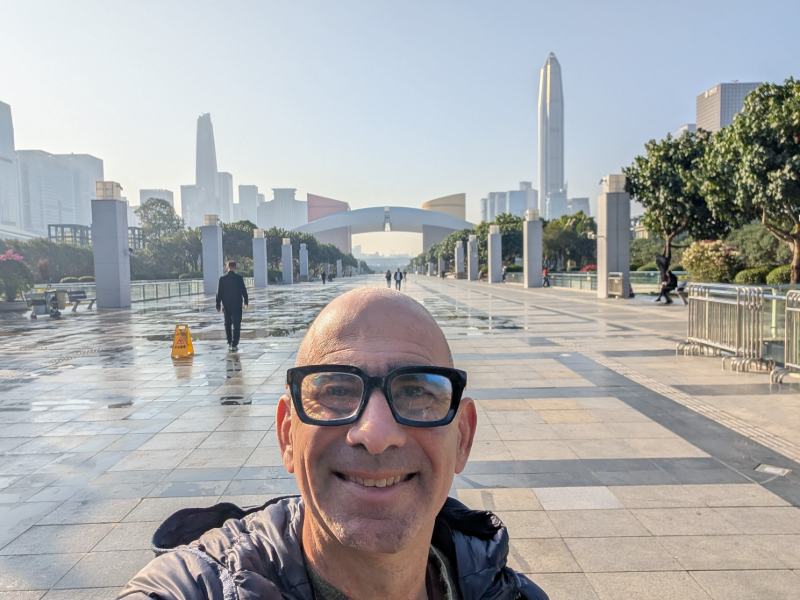

From the gleaming skyscrapers of Shenzhen to the tranquil riverbanks of Luang Prabang, my recent 10-day journey through Southern China was a whirlwind of high-tech marvels, ancient landscapes, and a few “cultural adjustments.” For those of us used to the “Right of Way,” traveling through China is a masterclass in a different philosophy: the “Right of Weight.”
Grab a cup of coffee and get ready to armchair travel through the “Great Firewall”, across southern China and into the heart of the East.

Shenzhen: The 30-Year Miracle
My journey began in Shenzhen, a city that transformed from a humble fishing village to a sprawling metropolis of 17 million people in a single generation. As many as 1200 people could be living on the same plot of land that housed you and your family of five when you were born just 30 years earlier.
My first stop was Lianhuashan City Park. In China, parks are not just for sitting; they are for doing. I watched seniors singing, practicing Tai Chi, flying kites, and one gentleman even serenading the trees with a lute.
I spent the afternoon strolling along the waterfront to marvel at the unusual, gravity-defying shapes of the modern architecture before heading to the older section, dominated by Dongmen Cultural Square.
Quirky Fact: While Dongmen is the “older” part of town, it has fully embraced the modern—it is also home to the very first McDonald’s ever opened in Mainland China (1990).
I finished in the evening at the Civic Center for the Light Show, where the entire skyline becomes a synchronized canvas of neon.

Guangzhou: Charm and the “Right of Weight”
I expected Guangzhou to be more of the same, but I was pleasantly surprised by its charm. Instead of demolishing its past, the city converted historical districts into showcases. I walked the Liwanhu riverwalk through the city’s main park and Enning Road, which is filled with tiny shops that litter the Opera district.
Nearby is Shamian, the historic British district. I noticed a few girls rolling suitcases and assumed they were travelers like me. It turns out they were locals filled with costumes for elaborate street-side photo shoots! Further east, I explored Xinhepu Road, where the city’s elite live on beautiful, tree-lined streets in the Donghu district.
The Scooter Survival Guide
Guangzhou is where I learned the rules of the road. The electric scooters are silent but deadly—and they are everywhere, including the sidewalks. Here is my advice for navigating them:
- The Right of Weight: Forget the “Right of Way.” In China, the bigger and faster you are, the more “right” you have.
- Hold Your Line: If you hear a beep behind you, it’s a notification, not a request to move. The riders have already calculated a path around you. If you move suddenly to be “polite,” you’ll likely walk right into their trajectory. Predictability is better than politeness.

Guilin and the “Venice of the East”
I took the high-speed train to Guilin, traveling across the landscape at up to 180 miles per hour. Outside the karst mountains played peek-a-boo as we went through numerous tunnels.
For a mountain town, it was larger than expected. Still sore from my daily hikes in Hong Kong, I decided to indulge in a tourist boat around the Venice of the East. The Two Rivers and Four Lakes tour navigates a 1,000-year-old moat system and takes you under 19 bridges, which are scale replicas of world-famous structures like the Golden Gate Bridge, the Pont Neuf, and London’s Tower Bridge.

Yangshuo: A Watercolor Dream
The highlight of the trip was the Li River cruise to Yangshuo. I’d seen those misty Chinese watercolor paintings my whole life but didn’t understand they were real landscapes until I was drifting through them. I splurged on a VIP cabin with a private balcony for unobstructed views.
In Yangshuo, I splurged again on a two-story room with a full-length window wall for the “exorbitant” price of $14 USD. The village has several walking streets, and the surrounding area has numerous outdoor activities to pursue. It’s the kind of town where you intend to stay a night and realize you need a week.

The Pivot: Guiyang and Kunming
To keep within my 10-day window, I moved on to Guiyang. It was cold and rainy, reminding me of my hometown of Portland. While I regretted leaving Yangshuo, the Guiyang parks were also lively, filled with seniors practicing sword play, badminton and ballroom dancing. My hotel was on the main food street, where I struggled to control my “eating” with so many creative local dishes.
In Kunming, I visited the Stone Forest (Shilin), a UNESCO maze of sharp limestone pinnacles. It was so big, I had trouble figuring out where to start but eventually put away my map and just began to wander the maze of rocks.
- Pro Tip: Arrive by 8:00 AM. By 10:30 AM, the tour buses arrive, and you will be “swimming like a salmon upstream” against thousands of tourists just to find the exit.
I ended my day at Green Lake Park, exploring until my phone battery almost died. In a cashless society, a dead phone is a crisis—without it, you cannot pay for a taxi, bus or even a bottle of water.

Getting Out of China
On my last day, I was both excited and nervous. Excited that I would be going to Laos, nervous that I could have the problem my dad cautioned me about.
On the train, I met two guys from Beijing who spoke great English and claimed to be traveling to Luang Prabang as well. I was somewhat cautious as their inquiries began to edge towards politics. I began to wonder whether they were Chinese agents sent to interrogate me before I left China.
As a tour guide to people from all over the US, I’ve learned the dance of avoiding giving my opinion about anything. I thought my belief was confirmed when I didn’t see them on the train after our checkpoint leaving China.
Once we reached the border, I employed an intentional strategy: get off the train fast and stay in the middle of the line. I reasoned that they wouldn’t want to hold up the whole train by questioning someone with 50 people waiting behind them.
Whether or not this was a correct assumption, I was quickly cleared and told I could get back on the train. I wasn’t relieved yet as the train was still in China. Apparently the staff wasn’t relieved as we were counted by at least seven different people.
After clearing China, we went through a 6 mile tunnel and emerged in Laos. It wasn’t even the longest I experienced. One of the tunnels was 10 miles long, and you remain in the dark for about 7 minutes as the train flies through it.
Laos was another customs stop over, adding yet another hour to the journey. The agents were a little more thorough than in China, but I again had all my paperwork in order and was quickly cleared. After stepping through to Laos, I finally messaged my dad that I’d made it out of China. A few hours later, I was relaxing on the banks of the river in Luang Prabang with a Lao beer in hand.

Reflections on a New World
China is a land of contradictions. It is entirely cashless—you need your phone to pay a food cart or enter the Metro. It is also a land of extreme surveillance; cameras are everywhere, and facial recognition can cite you for jaywalking before you’ve even reached the other side of the street.
Cultural Adjustments
You have to adjust to things that seem offensive in the West but are common there:
- Smoking in bathroom stalls despite the signs.
- “Cutting” in line despite the markings.
- Listening to videos on full volume without headphones.
- Loud burping and spitting.
I learned that the last one is because the Chinese think that it is unhealthy to “hold in” something that your body is trying to expel, and they actually think that it’s offensive for us to do things like blow our noses into a cloth and put it back into our pocket. Learning the why of these is part of the joy of travel. It teaches you to be less judgmental and more inquisitive. Every “offense” had a reason.
I’m not quite ready to run back. The challenge of trying to access all the electronic tools that I am dependent on through the “Great Firewall” was both frustrating and exhausting. Still the natural beauty and the amazing food are likely to draw me back again. The next time I go, I will be better prepared. I love learning, and there is nothing like travel to help you grow.
