

This has been the year for checking things off my list. I wouldn’t call it a bucket list, but I’ve had a mental tally of “must-dos” for years. Last month was the train from Hong Kong to Laos. This week, I closed the loop on Vietnam by train.
A decade ago, I rode the rails from Hanoi to Da Nang. This time, I tackled the southern coastal portion: a 590-mile stretch from Saigon (Ho Chi Minh City) up to Da Nang. As you might remember from my last post, a planning mishap almost derailed this trip, but I’m glad I pushed through.
My Strategy: The Four-Hour Rule
While you can ride the Reunification Express straight through for 19 hours (Saigon to Da Nang), experience has taught me that four hours is the “sweet spot” for train travel. It’s long enough to soak in the scenery, but short enough to disembark before the novelty wears off.

Mui Ne: Trash, Treasures, and Tailwinds
I hopped off at Phan Thiet to head to the beachfront at Mui Ne. The 40 minute taxi ride was nearly as expensive as the train ticket itself, so I recruited a fellow traveler at the station to split the fare.
Mui Ne is a bit of a contradiction. It’s a “scrappy” town that initially felt like a one-and-done visit, but it grew on me. I was hard pressed to find the highlights of the area. It certainly wasn’t the beach. All that existed on the shoreline across from my hotel was a sea wall and a fishing fleet.
The suggested attractions are the fish sauce factory and the sand dunes. Since I only had one day at the beach, I opted out of visiting the fish sauce factory, but I couldn’t help but prioritize the sand dunes. The first set of dunes were less than advertised, and the second set didn’t even exist!
- The 1st Dunes: While they look dramatic in photos, the reality is a bit depressing. The wind that molds their rippled texture also deposits town’s trash across them. I actually had to “pre-edit” my photos by moving a couple plastic bottles out of the frame first.
- My Bicycle Gamble: I had opted for the free hotel bike over an $8 scooter rental. This led to a gearless struggle over two significant hills in the heat, only to find the “2nd dunes” on my map didn’t actually exist.

- The Silver Lining: On my slog out, I’d seen motor scooters using the hard-packed sand along the surf line as a natural highway. I also decided to ride the coastline back, assisted by a perfect afternoon tailwind, and stumbled upon a beach cafe where I was the only foreigner. Perhaps that’s why I paid a 250% premium for an iced coffee, but as the owner insisted: “You’re paying for the view.” Considering it was only about $3.00 USD, I couldn’t argue.
The real joy of Mui Ne was my quiet little studio. It had a desk where I could work and an outdoor area with plant covered trellises to reduce the sun exposure. The wind was just enough to keep it cool, and if not cool enough, I could order a smoothie from the onsite restaurant. While this was solely an exploratory trip, I could see staying a week to relax as long as I stayed at the hotel.

Quy Nhon: The Next Big Thing?
The next leg would have been another 4 hours, but I skipped Nha Trang as I’d already been there. Instead I got off at Quy Nhon. Despite sounding like the inspiration for that mysterious American conspiracy group, this is another Vietnamese resort town. Add it to Da Nang and Nha Trang as a long strip of beach lined with high rise hotels. While Da Nang has its expat community and Nha Trang has its Russian community, I couldn’t quite figure out what made up Quy Nhon.
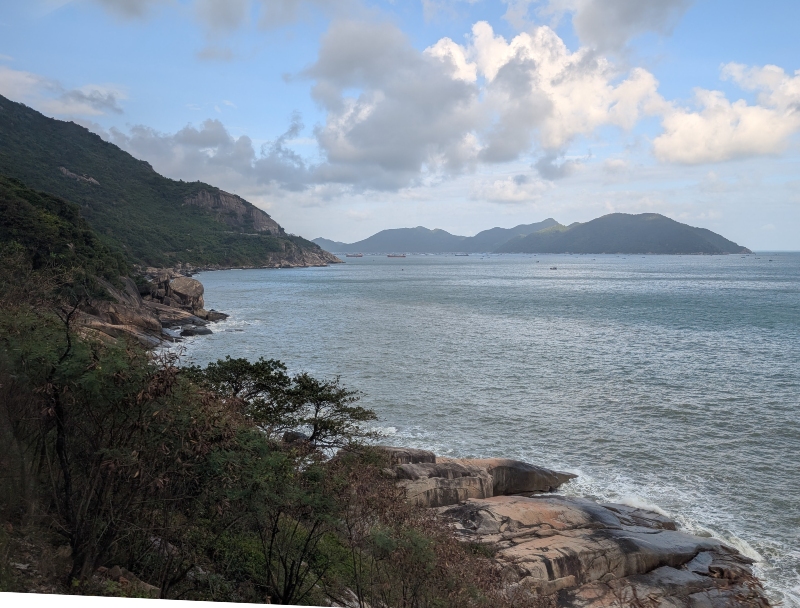
To find the soul of the place, I rented a motorbike and rode 30 minutes to the fishing village of Nhon Hai. It’s fairly quiet and still undiscovered by tourists except as a day trip. There are very few places to eat and even fewer places to stay, but I don’t imagine that will last long as it sits on an intimate inlet surrounded by dramatic rocky cliffs. With the wind blowing, I was hypnotized by the giant waves crashing into the rocks. I made note of this as a place worth returning to, though based on Vietnam’s supersonic growth, I doubt I’ll even recognize it then.

Life on the Rails: The “Food Roulette”
What makes breaking the trip into segments possible is the frequency of the trains. There are five trains a day, meaning you can almost always find a morning departure and avoid the dreaded 2:00 AM boarding call.
I took a motorbike taxi (one of the benefits of traveling light) and arrived at the station early. Across from every station is a coffee shop occupied by Vietnamese men sitting around drinking extra strong coffee and smoking cigarettes. They are there to monitor how tourists handle their unique style of coffee. Vietnamese coffee is so strong that it’s served with a warm glass of water to dilute the residue left on your tongue. They all seemed satisfied that I could handle myself.
The stations have loud speakers to announce the train departures so you can hear them from across the street, giving you time to wrap up your bill and head to the platform. I hopped on board and continued my northward journey.
A Pro-Tip for the Reunification Express: Mealtime happens when the food is ready, not when you are. On my first leg, I turned down the food cart at 11:30 AM, thinking I’d catch them on the return. Big mistake. About an hour later I watched as several empty carts headed back to the kitchen. I finally went to the front and asked about lunch, and they told me it was all gone. I didn’t make that mistake again.

Even though the food cart came through at mid-afternoon, I gratefully accepted their offer. The dining experience was a lot different than might be expected. While they do have a dining car, the seats are made of solid wood with straight backs. They reminded me of church pews. Because half the dining car is used for making food, you basically eat in the kitchen, so most people just eat from their seats.
Once the food is prepared, it is loaded into buffet pans which are placed onto a rolling cart. When the servers come by, they tell you the options in the kind of broken English that means you pretty much choose when to nod and see what you get. Every dish comes with a big scoop of rice and your meal roulette piled on top of it. The food was exceptionally healthy for a train, and it was obvious it was “home made” since I’d seen them prepping it in the dining car I scoped out earlier.

Da Nang: The “Miami of Vietnam”
Arriving in Da Nang felt like entering a different country. In just one year, the city has transformed. Last year I noted the tons of restaurants and coffee shops, but equally notable were the lack of people to fill them. This year the city was filled with tourists, as if the rains that brought so much water just a couple of months ago also washed in hordes of people.
It is the ultimate haven for the digital nomads that make up most of its foreign population. There are hundreds of cafes all with high speed internet. Credit cards are accepted everywhere, and there were at least three vegan restaurants within 2 blocks of my hostel. Add to that, a low cost of living and an international airport inside the city limits, and it’s easy to see why so many young people have made this home.
It’s a place where you can get anything you want within 20 minutes. Today, I decided I wanted a place where I could work on the beach with Wifi while drinking a smoothie. Five minutes later I was seated beneath an umbrella, sandals off, working on my laptop while I awaited my avocado smoothie.

It’s not yet too much, but it’s on the brink. When I see older foreigners driving around in motorized wheel chairs, I know a place has been “discovered”. It means the ‘rough edges’ that make travel an adventure are being paved over for comfort. The Reunification Line is finally complete for me, and it may have also marked my last visit to Da Nang, a place already called the Miami beach of Vietnam, because of its rapid development from sand bar to city. I travel to experience other cultures, but Da Nang feels like I never left home. Next week, I’ll try finding that feeling I had in Laos.