
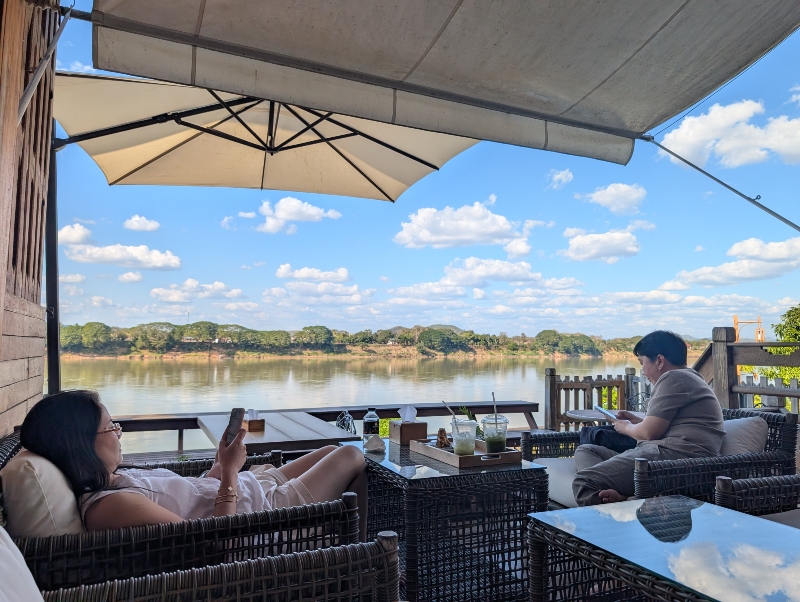

What is it about a frontier that just beckons?
I am sitting at a cafe in the Thai town of Chiang Khan, peering over at the shore of Laos just 500 yards away. Separating us is a river like any other, yet I feel an almost magnetic pull to cross it. Between sips of coffee and pages of my book, the activity on the opposite bank keeps stealing my attention.
The geography of identity here is confusing. One thousand miles south of this town, people speak the same language, use the same currency, and share the same lifestyle. Yet, a mere 500 yards across the Mekong, everything shifts. They speak a different tongue, eat different foods, and follow different customs. Their Lao neighbors define themselves as more distinct from the Thai people than those living halfway down the Malay Peninsula.
The Taunting Ferries
While I’d love to see how the world changes in those few hundred yards, it’s the “forbidden fruit.” This isn’t a designated international border crossing, meaning there’s no customs office to stamp a passport, and the simple boats ferrying people back and forth below me are a constant taunt.
I wandered down to the ferry landing the other day to investigate, and learned that locals are allowed to cross, but foreigners are expressly forbidden. I’d encountered this peculiar quirk a few years ago and a bit further upstream in the town of Chiang Khong (a name that, in English, is linguistically identical to the town I’m in). In these pockets, the river is a neighborhood street rather than a national boundary—but only if you have the right ID. In order to cross, you must be from the corresponding province from either side of the river. Not any Thai or Lao citizen can cross. Locals are given a simplified border pass which allows them transit.
Lines on a Map vs. Reality
It’s odd how nations go out of their way to avoid building crossings along these vast stretches of border. We see this in North America, too. While the US-Mexico border has the formidable Rio Grande and harsh deserts, the northern border with Canada is primarily just a conceptual line drawn on paper.
Take Point Roberts, Washington, for example—a geographical accident that left a piece of the US physically inaccessible to the rest of the country unless you drive through Canada first. I’ve spent time in Blaine, WA, where a Canadian city sits directly on the other side of the border. There’s no wall, no fence—just a lack of a road. In some spots, you can simply walk across the grass. I may have tested that theory myself once.
The Motorbike Reconnaissance
Looking at the Mekong from my cafe chair, the distance is so short you could easily swim it. Of course, you’d want to do it under the cover of night to avoid the authorities, but once you climbed up the muddy bank on the other side, who would know you didn’t belong?
Driven by a bit of “frontier fever,” I noticed on a map that the Mekong turns north just west of town, while the border continues south. I rented a motorbike to see if there were any “unofficial” paths where the river barrier disappeared.
Just like the 49th parallel, there were no roads crossing the frontier. I found a small creek that served as the boundary, but crossing it would have required some serious bushwhacking through a farmer’s field—a move that felt like a one-way ticket to a very awkward conversation with border guards.
After several miles of scouting, I conceded. My curiosity, though caffeinated, would have to stay contained for now. I returned to the cafe with my book. My crossing would have to wait until the next day when I headed for the official border crossing at Nong Khai for my flight out of Vientiane. The frontier remains, for today, a mystery viewed from a distance.