

Most people assume I have an iron stomach because I travel the world constantly eating street food. I remember once ordering from a food cart and only later looking down to see an open sewage trough flowing beneath the wheels. It is a strange truth that most of my bouts of food poisoning have occurred in my home country, and always at the hands of professional restaurants. But while I like to brag that I’ve never poisoned myself despite my “clean out the refrigerator” recipes, I don’t think I can lay the blame on Montezuma this time.
I arrived in Mexico City with an ambitious itinerary of bistros and bakeries, but I managed to derail the entire operation within the first week. Ironically, it was in my attempt to eat healthy. You’ve heard me grumble before about the ubiquitous “corn-based delivery system” that defines so much of Mexican cuisine. It’s essentially various forms of meat on some version of a tortilla, accompanied by exactly zero vegetables, unless you count the bowl of pickled radish and pepper slices as a salad.
The irony is that the mercados are bursting with colorful stacks of fresh produce, yet these vibrant greens almost never make it to the table. When I asked a local about this disconnect, they suggested that the vegetables go “into the sauces.” In a country where the tap water is best left to the plumbing, perhaps people feel more comfortable purifying their nutrition through the medium of a high-temperature simmer. Seeking to break the cycle of starch, I decided to take advantage of the full kitchen at my most recent pet sit. I went to the market, bought a fresh chicken, a mountain of vegetables, and set out to make a hearty, healthy soup.
The Petri Dish on the Stovetop
In a Mexican mercado, raw chickens are usually displayed along a tile counter, their heads dangling over the edge so you know it was once a live animal. Unlike the U.S., where your chicken was likely butchered the previous month, these birds are processed in the morning and sold by noon the same day. Usually, there isn’t time for pathogens to take root.
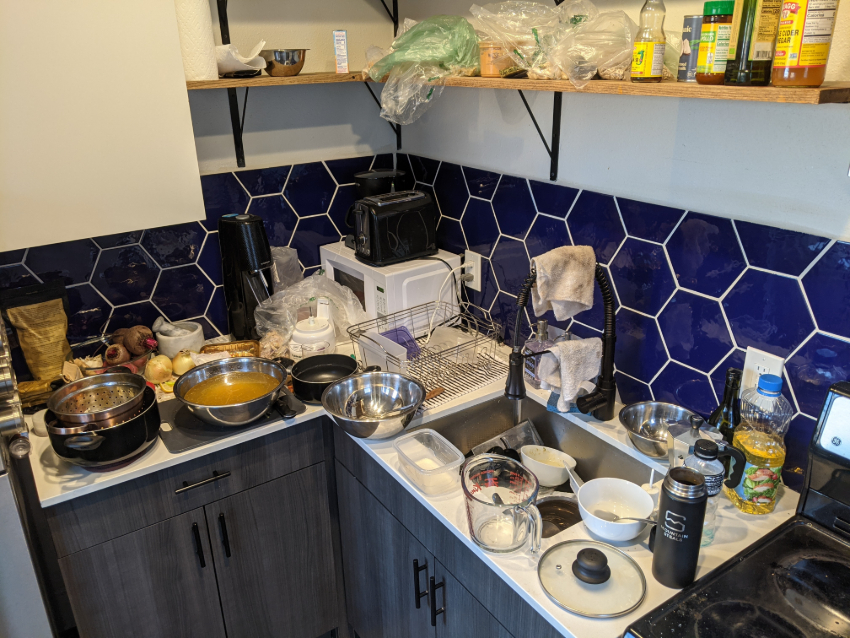
However, I managed to provide the perfect environment for a microbial orgy. After the soup was finished, I didn’t want to put the hot pot in the refrigerator for fear of spoiling the rest of the food inside. Instead, I left it on the stove top to cool. For several hours, I essentially maintained a lukewarm petri dish at the exact temperature required for salmonella to flourish and plan its invasion. While I managed to get the “purifying the vegetables” part right, I failed the basics of food safety. By morning, my intestines were giving notice, like a singer clearing their throat before a performance.
A High-Stakes Race to the Street
For the next two days, the only reason I left the house was to fulfill my duties to the pets in my care. Fortunately, there were potatoes in the fridge and rice in the cupboards. Anything else could be ordered for delivery. Though I considered hiring a dog walker, circumstances prevented that relief as well. To compound my misery, one of the dogs was battling his own gastrointestinal demons.
Negrito is 14 years old, a senior citizen in dog years, who normally navigates the apartment stairs with the cautious dignity of a man with a bad hip. But during this episode, he bypassed the stairs entirely, appearing to fly toward the bottom like a puppy seeing a door open to the outside. He bolted out the front entrance just in time to release his explosive diarrhea in the middle of the street. The scene was a nightmare of public humiliation: midday in a neighborhood already weary of canine waste, with people milling about while I stood perplexed.
There is a specific kind of excrement that renders a plastic doggie bag nothing more than a decorative glove. I bent over, painfully aware that I might find myself in the same compromising position as the dog in the next few minutes, and I attempted to “wipe up” the liquid with my digital prophylactic. It was about as effective as trying to serve chicken broth with a chopstick.
The myth of an iron stomach
We spent the next several nights in a silent, desperate competition to see who had the greater urgency. We would eye each other empathetically from across the room, waiting to see who would make the first frantic dash for the hallway. It was a bonding experience of the worst possible kind; a shared mutiny of the gut that left us both hollowed out and yearning for relief.
It was a stark reminder that while I may have survived the “open sewage troughs” of the world’s street food stalls, I was not as invincible as my travel stories suggested. It wasn’t Montezuma’s ancient curse that brought me to my knees. Nature doesn’t need an avenging emperor with a historical grudge to teach a lesson in humility; it just needs a lukewarm pot of soup and a man who thinks he’s too seasoned to follow the rules.
Next time: The DMZ of Dog Walking—How I learned to navigate the minefield of neighborhood canine politics while avoiding Blanco’s attempts to start a local revolution.