
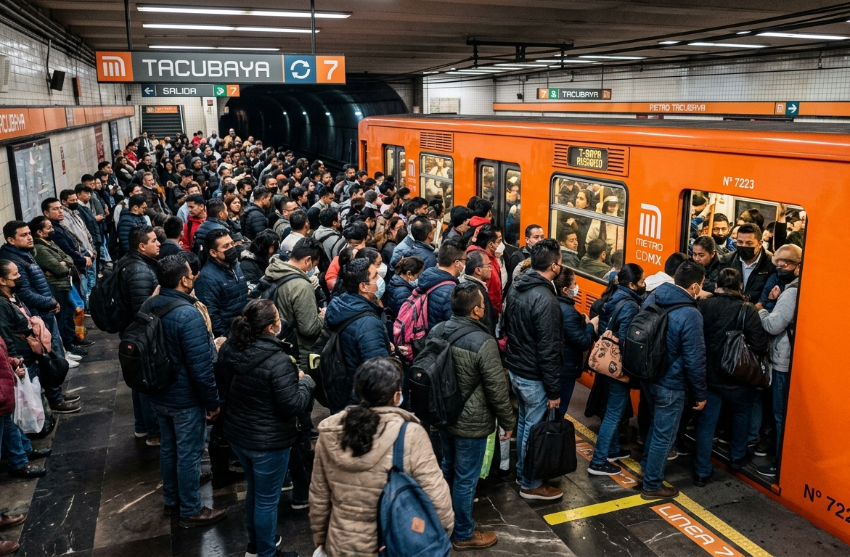

The Mexico City Metro is a subterranean marvel that manages to be simultaneously the greatest bargain in the Western Hemisphere and a claustrophobic’s worst nightmare. To understand the scale of this operation, you have to appreciate that 5.5 million people ride these rails every day. With 9-car trains holding upwards of 3,195 people at peak hours, the system can theoretically play host to 400,000 passengers simultaneously across the network during peak periods. That means at any given time, almost half a million people are beneath the capital, hurtling through tunnels, like a prairie dog town gone high tech.
If you find that number staggering, spare a thought for the commuters in Shanghai, where the daily ridership hits 12 million. It makes the Mexico City experience feel almost intimate, provided your definition of intimacy includes having your head tucked under a stranger’s arm pit as they grasp for the inadequately distributed handrails overhead.
Giant Scavenger Hunt
While this massive system connects the city to the airport, major bus terminals, cablebus, commuter rail lines, and even the canals at Xochimilco, good luck finding it! Most metro station entrances in Mexico City are camouflaged by hordes of pop-up vendors, like mounds of discarded dirt around an ant hill. Others are camouflaged by policy.
One of the best-kept secrets in travel—largely because the taxi cartels would prefer you didn’t know—is that there is a Metro station at the airport. You won’t see any signage for it however. Instead, you must walk to the westernmost end of Terminal 1, exiting through Puerta 1, and keep walking until the world starts to look a bit more “local.”
You’ll pass a taxi stand positioned strategically at the door. Ignore their declarations that they are the only transit option from the airport, and follow the airport workers as they walk along the sidewalk. Eventually, you’ll spot the orange “M” logo, and for the sum of 5 pesos, roughly 30 cents, you’ve got a traffic-free escape from the airport, while the folks in the “authorized” taxis are still negotiating the first stoplight. It is the only place in the world where you can travel across a megalopolis for the price of a pack of Chiclets, those little yellow squares of gum sold by every enterprising kid in the city.
Navigating the Maze
Inside the station, you have two payment choices: the Taquilla (ticket booth) or the Metro card. I suggest the card. It costs about 15 pesos (less than a dollar) to buy, and you can tap your way through the turnstiles. The lines at the ticket booths during rush hour resemble the queues at the DMV at mid-day.
Like any metro system, once you get through the turnstile, you have to find your train line. Navigation is actually fairly logical once you grasp the “Terminal Station” rule. Signs don’t usually say “Northbound” or “Southbound.” They tell you the name of the very last station on the line. If you’re heading toward the Zocalo, the city center, know the terminus of the line that goes to the Zocalo from your station. Of course, if you have to transfer, you want to make a note of that station, the second train line, and its terminal station so that once you get off, you know where to go.
When you disembark, you’ll see one of two signs:
- Salida: The exit. Use this if you wish to see the sun again.
- Correspondencia: The transfer. Use this if you wish to continue your journey on a different line.
Be warned: some “Correspondencia” walks are nearly half a mile long. At least they try to keep you entertained. Some walks expose ruins they found when digging, others have underground museums. The tunnel at the La Raza station, for instance, features a “Tunnel of Science” with astronomical displays to keep you from realizing you’ve just walked halfway to the next city underground.
The Survival Guide
The platforms offer a unique look at social engineering. On the right end, beyond orange barriers, you’ll find sections cordoned off for women and children. This is a welcome reprieve from the “Padding Effect” of the general cars. When the train is truly packed, you aren’t so much standing as you are being held upright by the collective pressure of forty other people. On the plus side, if the train hits a sharp curve or stops short, you won’t fall; you’re simply pressed into your neighbor like a stack of vertically stored mattresses.
However, this density is a buffet for pickpockets. I once had five people in my tour group get relieved of their wallets simultaneously—a feat of efficiency that would make David Copperfield gasp. Keep your backpack against your chest and your valuables in places a surgeon would struggle to reach.
Pneumatic Physics and Rubber Wheels
You might notice the trains run on rubber tires. Because rubber has much higher friction than steel-on-steel, these trains can speed up and slow down significantly faster. In a city where you are trying to move 5.5 million people with trains arriving every 120 seconds, those extra seconds saved at every station add up to massive increases in total system capacity.
The tires aren’t just for velocity changes, they’re for traction. Mexico City has significant elevation changes. Steel wheels on steel rails are prone to slipping on inclines. Rubber tires can handle much steeper “grades,” allowing the tunnels to follow the city’s natural dips and rises without needing to be dug excessively deep or perfectly level. And because the ground in Mexico City is prone to “differential settlement” (meaning one part of the track might sink faster than the part next to it), a rigid steel rail system would be a maintenance nightmare, constantly snapping or warping. The rubber-tire system is slightly more forgiving of tracks that aren’t perfectly aligned.
They also produce significantly less ground vibration. In a city with fragile colonial architecture and shaky soil, heavy steel wheels clattering along could actually vibrate buildings apart over time. The rubber acts as a massive shock absorber for the city above.
When the train arrives, be swift. The doors stay open for about sixty seconds, and they are powered by pneumatic systems that close with about 150 pounds of pressure. It’s not just a suggestion; it’s a physical ultimatum. These doors operate on the principle of “everything in or everything out.” Do not try to hold them. You will lose. Fortunately, if you fail to board, don’t fret. Another one usually arrives every two minutes. It is a relentless, vibrating, 35-cent miracle of engineering that remains the beating heart of the city.
Leave a Reply