
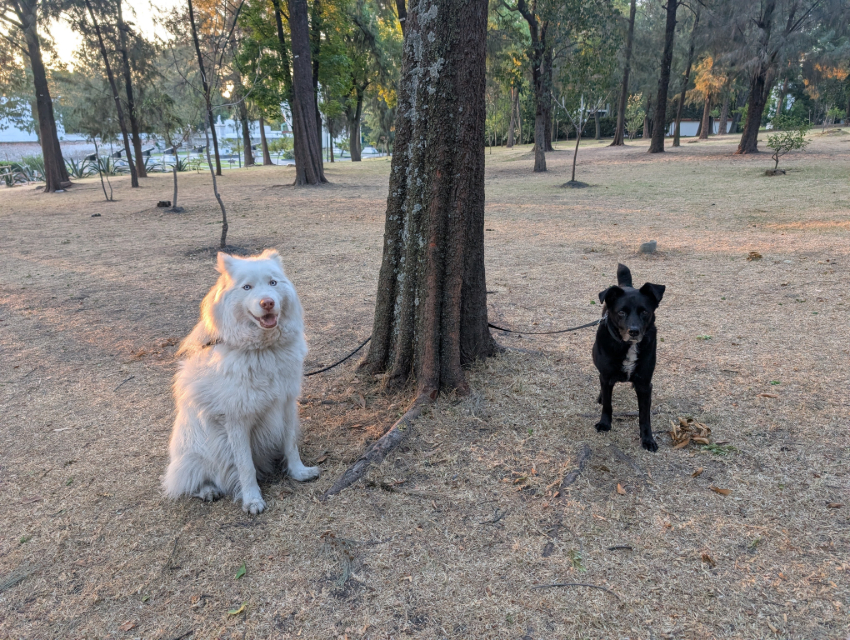

As I mentioned in a previous post, the demographic tide has shifted in San Miguel de Chapultepec. The neighborhood has seen an influx of new residents who, like their counterparts in the trendy Condesa across the way, have brought their dogs in droves. However, while Condesa boasts expansive dog parks where canines can frolic and relieve themselves with abandon, San Miguel offers only the front entrances and parking strips of the local residents.
The locals have responded by posting signs politely, and sometimes pointedly, requesting that dog owners discourage their animals from using their doorsteps as a public latrine. These signs carry the misplaced assumption that a human has any say in where a dog chooses to lift its leg, though I once saw a guy attempting to pull his dog away while it hopped on three legs mid-stream. Consequently, the neighborhood has taken on a certain aroma of urine and sun-dried feces—though, to be fair, I spent years living in San Francisco, where humans frequently engaged in the same practice with far less reservation.
The Grandfather and the Delinquent
The true challenge, however, was the conflicting dispositions of my two charges. Negrito was the grandfather of the duo, while Blanco was an adolescent boy with the soul of a persistent troublemaker. Blanco is what I call a “shit-stirrer-upper.” He possesses that specific brand of teenage curiosity that is constantly trending towards mischief.
He spent the better part of our walks wedging his nose into the gaps beneath garage doors where he knew other dogs resided. I suspect his intentions were friendly, but as any observer of canine psychology knows, a dog behind a barrier reacts to a greeting with the same level of measured restraint as bees defending a hive.
Every street corner demanded I be on high alert. At the mere sight of another creature, Blanco’s first instinct was to leap. I was never entirely certain if he intended to play or devour, but since “not knowing” is a poor strategy for avoiding a dog fight, I kept the leash taut and my eyes peeled for potential kerfuffles, often reigning him in as we approached.
Navigating the Minefield
Walking these two became an exercise akin to navigating a minefield. The established social contract in the neighborhood dictated that when two dog owners see each other, they immediately cross the street to avoid any incidents. This system works elegantly until there are more dogs on a single block than there are sidewalks to accommodate them.
At peak hours, intersections become a gridlock of diplomacy. You’ll find yourself standing in the middle of a busy street, holding your dogs at bay, while another owner scurries past, both of you exchanging gratitude for each other’s understanding. If I timed my walk poorly, I spent half my journey dodging traffic in the street just to avoid a canine confrontation on the sidewalk. At least the cars were predictable.
The Timing Solution
My first solution was to adjust the walking hours. Since I wake up early, I decided to take their dogs for their morning walk at 6 AM, two hours before the rest of the neighborhood’s canine population spilled out onto the sidewalks. The afternoon was a little trickier, but I settled on 3 PM since everyone had probably returned to work after their late lunch and most people worked until at least 5 PM. Unfortunately, this was not a guarantee that the streets would be dog free, so I tried other options.
One led me to the western edge of Chapultepec Park, to a section known as Los Pinos. Nominally, the park does not allow dogs, but this one section serves as the gateway to Chapultepec 2, which does allow dogs. I took advantage of that by using the gateway as my dog run. I did have to head out early though since that same gateway serves as the pedestrian corridor for commuters walking between the Cablebús and the Metro.
The Staggering Solution
Even then, the stress of managing the Grandfather and the Delinquent simultaneously was too much for my salmonella-weakened constitution. I finally hit upon the revolutionary solution of walking them separately. It doubled my time on the pavement, but the psychological relief was immediate.
Walking Blanco alone allowed me to actively monitor his “shit-stirring” tendencies. It also gave us the freedom to explore further afield into neighborhoods I hadn’t yet scouted, but the real surprise was Negrito. Without Blanco constantly pausing to anoint every vertical surface in the district, the old man actually trotted. It was the fastest I had seen him move since his “explosive” dash to the street a week prior.
By the time Jason returned three weeks later, the house was intact, the neighborhood diplomacy was maintained, and he was especially pleased to find that Negrito was not only alive but seemingly rejuvenated. I, on the other hand, was ready for the next leg of the journey. I headed to the town of Taxco, where the steep hills turned the focus of my vigilance from avoiding confrontations to avoiding a headlong tumble down a cascade of steps.