
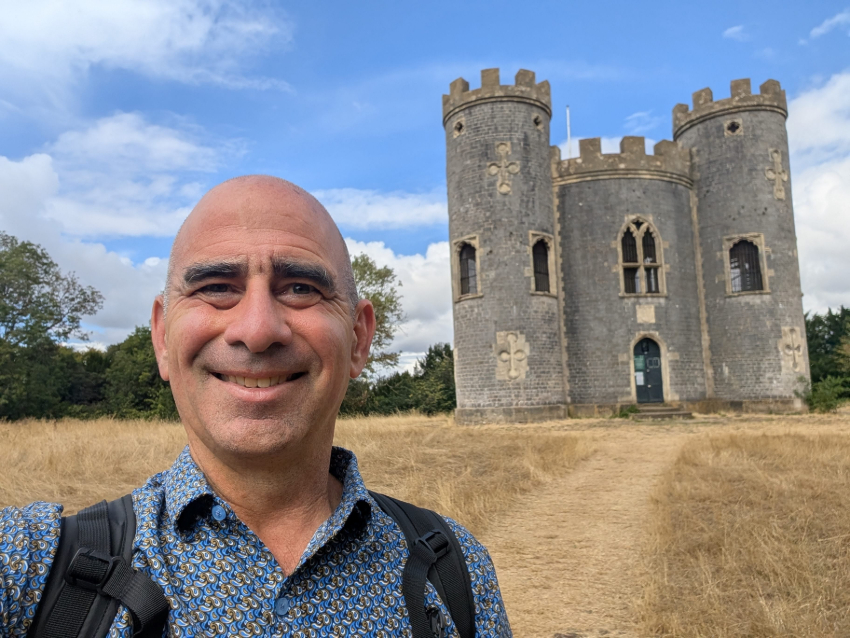

A wild hair
I can’t think of a better expression than “I got a wild hair up my…” to explain my sudden impulse to hop across the Atlantic for a few weeks between tour assignments. One of the reasons I chose to work once a month was so that I could make some money and then travel between tours. It was purely theoretical until this summer.
Sure, I’d visited friends and family during previous breaks, but those were all convenient trips when I was already in California or Oregon. Until this summer, a jaunt to a foreign country for three weeks between tours was purely a hypothetical idea I’d sold myself on for living this lifestyle.
Last winter, I read a book on “Slow Travel.” It extolled the noble art of lingering in one place rather than sprinting through a bucket list like a frantic reality show contestant. It waxed poetic about traveling by train, bus, and foot, introducing me to the ancient British Pilgrimage trails. Spain’s Camino de Santiago gets all the press, but Europe is crisscrossed by these historic footpaths, anchored by cozy inns spaced conveniently a few hours’ walk apart.
I love walking and the romantic notion of tramping along until my legs give out, then rolling into a village pub for the night. A visit to England last fall had convinced me it was well appropriated for such an endeavor. So, armed with airline miles, I booked a round-trip ticket sandwiched between my two August tours.
Things go awry

My first tour wrapped up in Bozeman, Montana. Planning to connect through Denver and on to Heathrow seemed simple enough and, coincidentally, my flight out was scheduled within 20 minutes of the flight of my guests, who I’d just taken on a tour of Yellowstone and Grand Teton national parks. Unfortunately, their plane departed as scheduled, while mine remained on the tarmac.
Thunderstorms over Denver had locked down the airspace. Initially, I wasn’t worried as I had a two-hour buffer in Denver, but an hour’s delay became ninety minutes, and then two hours. At the gate, the agent offered the trademark airline shrug of mystery regarding my connecting flight. Coincidentally, this was the same agent who had earlier informed me that the previous flight for Denver, that was boarding when I arrived at the gate, was full. Had I pressed the issue—mindful of the old “bird in the hand” axiom—I’d have made my London flight. Instead, I sat marooned in Montana.
The other Newark
Having missed my connection, I arrived at London’s Heathrow airport a day later than expected. From there, I took the Underground to King’s Cross—the station rendered famous by Harry Potter and crowded by tourists searching for hidden brick walls—before boarding a train for Newark.
My first destination was a visit with Pearl, a 65 year old force of nature I’d met the previous year on a riverboat cruise along the Mekong in Thailand. When I first saw her, I’d written her off as another quiet, unassuming retiree. But when we found ourselves the only two Westerners on board, I ambled over to introduce myself. Usually, as a tour guide, I am the designated storyteller, expected to regale wide-eyed listeners with tales of the road. When I asked Pearl how she ended up in Southeast Asia, she offhandedly replied, “Oh, I’m sailing around the world crewing on yachts.” Not another word was uttered about my unusual life for the rest of the voyage.
We’d stayed in touch, and she invited me to use her hometown as my first stop in England. She was working when I arrived but suggested several things I could do until she came home. Having slept minimally on the flight, I told her I might just find a place I could take a nap. Without hesitation, she said she’d leave a key and that I could just find my way to the guest room when I arrived.
Once I’d slept off the jet lag and Pearl had finished catering a local soccer match, we embarked on a whirlwind forty-eight hours of “The Great British Experience.” She was determined I should sample all of the traditions of the area and England in general. Night one involved an outdoor pub gig and dancing. Day two featured a pilgrimage to Sherwood Forest, visits to historic cathedrals, and a ruined castle. We had a proper English breakfast, tea in the afternoon, and that evening we attended trivia night at another pub. Unfortunately, our long day precluded us from trying the famous British Sunday roast. I had to hand it to her though, she was a great tour guide, and it was fun for me to be the guest for a change.


Coventry
Pearl deposited me at Nottingham station, where I caught a train to Coventry. My destination was to see Dave, another acquaintance from Southeast Asia. We met a few years ago when I came down the stairs of the hostel at 6am on my first morning in Saigon. While bleary-eyed twenty-somethings stumbled past us muttering “good night,” Dave greeted me with a hearty good morning. We connected immediately, and I invited him to join me for a Vietnamese egg coffee making class that morning. To my surprise, he agreed, and we’ve reunited several times in Vietnam and Thailand since then. A retired British firefighter, Dave was now hosting me in his native habitat of Coventry. To be honest, though, I think he looks a lot more at home in Asia at this point.
I only had a couple hours in Coventry, an extended transfer on my way from Newark to Bristol, so we made our way directly to one of its highlights: the skeleton of a cathedral bombed during WWII. He explained to me that Coventry was an industrial center during the war, and by that rationale, a target for the Nazis. We then grabbed a bite at J.D. Wetherspoons, a place he called the quintessential British pub experience.

I had my doubts. To an uninitiated American, Wetherspoons—or “‘Spoons” as the locals call it—feels a bit like a Denny’s that swallowed a chain of historic taverns and standardized the menu. Dave and I lowered the average age in the room by at least two decades. But Dave defended the institution: ‘Spoons buys up grand, decaying historic architecture—Victorian banks, Art Deco picture houses, old opera houses—and preserves them while serving dirt-cheap Fish and Chips and Sunday Roasts. Besides cheap food, it’s popular with the older generation because the pubs don’t have any music. The idea is that it is quiet enough that you can have a good conversation, something especially important with a demographic that is hard of hearing. It’s equal parts McMenamins and community center for pensioners.
The chain was founded in 1979 by Tim Martin, a law graduate who bought his first pub in London. The unusual name comes from two sources: “J D” was inspired by Sheriff J. D. “Boss” Hogg from the American television show The Dukes of Hazzard. “Wetherspoon” was the surname of one of Martin’s former schoolteachers in New Zealand, who had allegedly told a young Tim that he would never amount to anything and would never be able to run a business.
After our geriatric grub, Dave ushered me to what felt like a more authentic experience: a pint of beer at the oldest pub in Coventry. The archetype matched my expectations: oak-beamed ceilings so low they demanded a stoop, hidden alcoves built for highwaymen plotting coach robberies, and brass hand-pumps lined along the bar like naval cannons.

With 20 minutes until my train, we sped off towards the train station when Dave realized he’d forgotten to show me Coventry’s most legendary monument: the statue of Lady Godiva riding side-saddle while topless. Dave slyly informed me of the local theory that the original medieval poem merely stated she rode bareback—meaning without a saddle—and that a centuries-old literary misinterpretation created the famous nudist legend. Naturally, a statue of a fully clothed woman on an unsaddled horse wouldn’t draw nearly as many tourists.
My next stop was Bristol, and I feel I should pause at this point to address that so far, I’d been traveling at a pace that was anything but slow. The justification for this is that I had a few days in England before I had scheduled slow travel to begin. To save money and give myself time to get the lay of the land, I had booked a one week pet sit in Bristol. It was conveniently located just across from Wales and at the beginning of England’s SW Peninsula. With three days to get there, I had decided to visit a few friends along the way.
Bristol and the Avon Mud Stream
The house sit in Bristol proved to be the perfect choice. The home was spacious, modern, and backed up against a park. The weather was so wonderful all week that it made it hard to not spend every day reclined in the backyard listening to the birds as the sun lulled me to sloth. But, I also knew I would regret it if I didn’t devote a little time each day to exploring, and each day brought a new reward.
The first day I explored the town of Bristol itself. My train had arrived too late the day before to catch the river ferry, so I headed back to the town center and bought a day pass so that I could travel up and down the canal in its entirety. I say canal because the water running through the town is kept there artificially. Without the great locks at the town’s western end, all of the water would disappear twice daily with the tide as the Avon river empties itself into the Celtic sea. It was an ingenious way to keep the city navigable by boat, though now most access is provided by drawbridges.

I got off the ferry and walked through St Nicholas market, a collection of shops and international restaurants catering to the city’s business crowd and tourists. When riding the ferry, I couldn’t help but be drawn by a giant clock tower standing above the city so after nourishing myself, I headed uphill. After reaching the tower, I saw it was just a short walk to the Clifton Suspension bridge, another Bristol highlight, so I continued to it. The bridge is an awesome spectacle, suspended above a 245 foot Gorge. While the views from above were great, I convinced myself that I could get an even better photograph from below. I crossed the bridge, made my way to the bottom of the canyon, and found myself at the muddy banks of the Avon river still draining what little was left of its volume.
The tall shrubs growing along the bank obscured the photo I had planned from the base of the bridge so I carefully pressed through them. The other side was made up of reeds growing from soft silty mud, and I knew I had to be careful as it was the kind of viscous substance that would deftly wrap around your foot and steal your shoe the moment you tried to lift your leg. As I gingerly probed the bank, my mind drafted two distinct ways to perish there: either lose my footing on the steep slope and toboggan into the murky gutter of the Avon to drown, or sink knee-deep into the quicksand-like silt, cemented in place until the Atlantic tide slowly covered my head in water. I hastily snapped my picture and retreated from the bank.

I took the next day off and spent it safely in the backyard reading, sun bathing and trying to mirror the simple life of the dog.
Cardiff and “Welshman’s Caviar”
Day three took me across the Severn Estuary to Cardiff, the capital of Wales—a quick 45-minute train ride through a tunnel beneath the Bristol Channel. I had looked into taking a ferry, but apparently the massive tide changes made consistent service impossible.
Uncertain of what to do in Cardiff, I consulted AI, which suggested exploring Cardiff’s famous Victorian shopping arcades. These glass-roofed alleyways were the 19th-century precursors to the modern mall, designed to keep shoppers dry while enforcing strict standards of public decorum. Inside, I found tourist shops and local eateries, including one serving Laverbread—often dubbed “Welshman’s caviar” by literary locals like Richard Burton.
Despite the name, Laverbread contains no wheat. It is an iodine-rich seaweed harvested off the rocky Welsh coast, boiled into a dark paste, rolled in oatmeal, and pan-fried with bacon and cockles. As I choked down the salty, nutrient-dense sea-sludge, I couldn’t help but wonder why we insist on romanticizing “delicacies” that were clearly invented by desperate medieval ancestors trying to survive a brutal winter of hard labor.


Cardiff was as unimpressive as its food, and after walking around the city for a couple hours, I decided the best way to enjoy it was to leave it. To be fair, Wales is known more for its natural beauty so trying to find beauty in its capital city is like trying to experience California by visiting Sacramento.
The Great English Road Trip
One of the main reasons I chose Bristol was because of the nearby Cheddar Gorge, England’s deepest canyon. Despite its proximity to Bristol, getting there by public transit would have taken 2.5 hours each way. That would have only gotten me to the mouth of the canyon, and it seemed like something you should drive through, so I chose to rent a car for this excursion.
To maximize the value of my rental, I looked at other places I could visit during my 24 hour rental period. I decided I would visit Portishead, simply to see the town that was the band’s namesake. Since I had to go through Weston Super-Mar on the way, I added that to my list of stops. And finally, I figured on arriving in the town of Wells in time for Sunday roast.

One thing I hadn’t planned on was learning how to drive. Having grown up with a VW bug, I knew how to use a manual transmission, and having driven a car in Thailand, I had experience driving on “the other side” of the road. What I had no experience with is doing both at the same time. At least neither the stick shift nor the pedals were reversed; they were just in different locations, and my brain was fairly quick to adjust to operating the stick shift with my left hand. The turn signal was a different story. My brain became dyslexic, assuming every lever had to swap sides, so I spent the first hour indicating my turns by activating the windshield wipers.
Portishead
The port at Portishead has created locks to deal with the massive tidal changes and to allow boats to come and go to the sea. It also keeps the boats upstream from the lock afloat even with the recession of the tide, unlike those outside the lock. I grabbed a coffee and walked along the muddy waterfront before moving on to the next town.


Weston Super-Mar
First of all, you can’t help but expect great things at a place with a name like Weston Super-Mar, but in reality, the name simply translates to Weston above the sea. I’m not even sure why they say “above” since most of the city sits right on the waterfront, at least at high tide. At low tide, the city’s main attraction, the Grand pier, stands on hundreds of pilings that make it look like a centipede tethered to the seawall.
The other attraction is the city’s outdoor pool. It is a triangular shaped lagoon that holds seawater for swimming regardless of the water level around it. There is even a tiny beach at one corner where everyone congregates when the tide has left the other beach with nothing lapping at it but mud flats.


Cheddar Gorge
I had driven my route counter clockwise, visiting these two towns first, because I wanted to drive the Cheddar gorge from West to East. While I knew this meant I would be arriving at peak visitation time in Cheddar, I had no idea the volume of visitors this place received or how little space was available to contain them.
Cheddar, the birthplace of the world’s favorite cheese earns its tourism as a picturesque village in its own right. One narrow road winds through the buildings and a waterway that also makes its way through town. While much of the traffic is caused by the volume of people visiting a town with limited parking, several narrow choke points also slow the flow by permitting only one direction of travel at a time. I drove all the way through town without locating a place to stop and considered scrapping the visit all together before I found a parking spot up the canyon. I walked back to town to investigate.

The town itself felt like a quaint British equivalent of Gatlinburg, Tennessee: a dramatic natural canyon somewhat compromised by mini-golf, escape rooms, and 3D virtual ride attractions. A quick walk through town showed there was little to offer me besides the eateries, which all had hour-long waits because I had chosen to arrive around noon on a Sunday.
Seeking escape from the hordes, I hiked up a steep trail expecting a sweeping, Grand Canyon-style panoramic view into the gorge. Viewpoint after viewpoint failed to provide anything more than a vista of the valley leading to the Gorge. By the time I gave up, I had hiked almost halfway along the six mile Gorge loop trail so I decided to just walk down the road from the top of the Gorge to my car. As it turns out, the views I was looking for were actually from the bottom. I marveled as I strode into the canyon, occasionally having to make way for cars trying to get through tight openings between cliff edges. I repeated the experience, only in reverse, as I drove out of the canyon.

Wells and the Sunday Roast
By the time I reached Wells, it was almost 4pm, and I was at risk of once again missing Sunday Roast. I can’t tell you the number of times I’ve tried to enjoy this British tradition that is typically a hearty, multi-course meal centered around roasted meat, Yorkshire pudding, vegetables, and gravy. The reason I’ve missed it multiple times is that I usually go looking for it around dinner time. As it turns out, it’s more of an afternoon meal, and even the times I’ve showed up in the late afternoon, they’ve run out of meat.
The promising pub I walked into said they were only doing BBQ, which is not the traditional experience I was hoping for. The bartender recommended a place called Sheep and Penguin. Given the name I wasn’t sure what to expect, but I was curious to see their logo. While it wasn’t the signage I had imagined (a sheep conversing with a penguin), they were still serving Sunday roast, and I was finally able to check this British experience off my list.


With not much time to spend in Wells, I quickly got to walking around the town which was impressive for its disproportionately massive cathedral and a castle complete with moat. It is described as the smallest city in England, and it is very charming.
Bath
The last day trip on my list was Bath. I’d been excited when I first heard about the Roman Baths here, but that’s because I was envisioning the Turkish baths which are still in operation in Istanbul. The Roman baths in Bath are an architectural relic, however, and there was no spa experience to be had at the original structure.
While the town offered tours of the baths, the town itself was an architectural highlight, and I spent my visit roaming the streets admiring the pink hued Bath sandstone that composed the structure of most of its buildings. There were plenty of other homages to Roman design including a couple of town house block circuses. These are townhouses in succession that form a curve (circus = circle) around a central green.


The other attraction in town is the Pulteney Bridge. Its design was inspired by the Rialto bridge in Venice and is also covered with shops on both sides. Adding to its drama is a cascade of water created by a weir just below the bridge. The weir was introduced to reduce flooding upstream.
My visit to Bath rounded out my day trips during my stay in Bristol. While I hardly sat still, it was nice to remain in a single location and simply explore my immediate surroundings more closely, a theme I would continue to finesse throughout the trip.
Next: How my walk around the SW tip of England ran into a wall.