
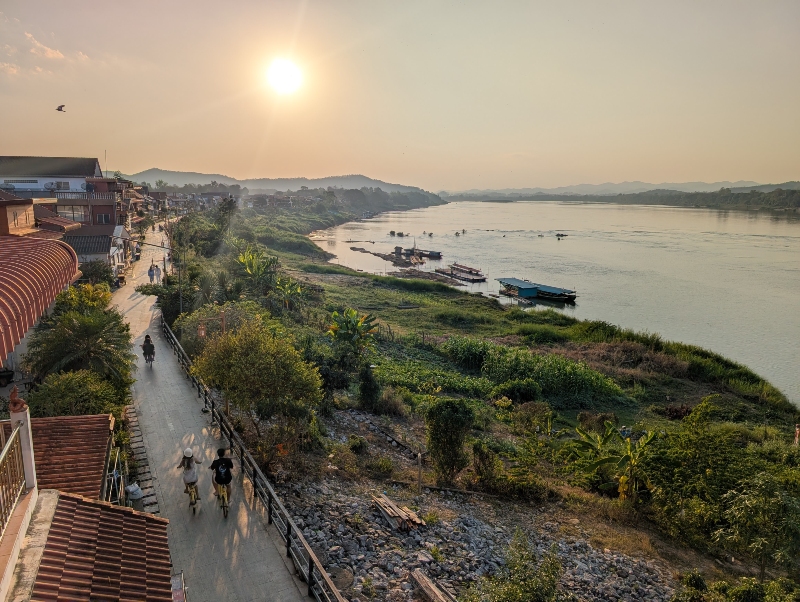

After a multi-stop train journey up the coast of Vietnam, I found myself longing for the relaxed atmosphere of Laos. Since my return trip to America was set to depart from Thailand, I started looking for a Thai destination that could offer that same tranquility. I was struggling to choose between various beaches and islands when a thought struck me: I missed the slow flow of the Mekong.
I decided to enlist Artificial Intelligence (AI) for help. I asked Gemini, Google’s AI, “Are there any cities in Thailand that have a similar feel to Luang Prabang in Laos?” The answer was impressive enough to alter my expectations of both AI and Thailand.
Gemini’s verdict: “While no single city in Thailand is an exact carbon copy of Luang Prabang’s unique UNESCO-protected blend of French-Colonial and Laotian architecture, Chiang Khan captures its serene, ‘slow-life’ spirit.”

Like Luang Prabang, Chiang Khan is massaged by the constant flow of the Mekong River. It shares that same tranquil, early-morning atmosphere where the mist hangs low over the water. The similarities don’t end there. Much like the night market in Luang Prabang, Chiang Khan features a nightly “Walking Street” lined with beautifully preserved two-story wooden houses converted into boutique stores and cafes. Every evening, food vendors set up stalls, creating a mile-long buffet line for passersby. If you’re a morning person, you can witness the tradition of alms-giving to monks similar to the one in Luang Prabang.
The main difference between the two? Chiang Khan remains relatively undiscovered by Western tourists. That’s not to say it isn’t busy. The town is incredibly popular with Thai weekenders, but once Sunday rolls around, the streets become as quiet as the river beside them. What struck me as particularly curious was that the cycle of waxing and waning tourism isn’t just weekly—it’s daily.

Because many Thais are Buddhist, you see them out at dawn, lined up to make their contributions to the monks. To be honest, the display feels like as much exhibitionism as it does generosity. There is always someone on hand to photograph the donation—sometimes a friend or family member, other times the very vendor who sold them the pre-packaged gift basket.
The locals are quite entrepreneurial. They realized they could profit from the morning rush by rolling out carpets and selling “ready-to-go” alms kits for tourists to offer up. It made me wonder if the monks would have simply preferred the cash.
I couldn’t help but compare the whole affair to Halloween. You have groups of kids (many monks are orphans sent to monasteries for care) dressed in “costumes,” walking through the neighborhood holding out bags for treats. At the end, instead of a “thank you,” the monks sing a short blessing, but the familiarity of the process was hard to dismiss.

Once the monks return to the temples to sort and trade their loot, the town is left with a crowd of tourists who have nothing to do at 7:00 AM. That’s when the next phase of marketing begins, and I was surprised to see the streets as busy in the morning as they were the night before. Many shops open early to sell scarves and jackets against the morning chill, while restaurants lure people in with the steam wafting from cauldrons of rice porridge and hot coffee.
By 9:00 AM, when the sun finally touches the street, most of the shops are shuttered. The tourists have either retreated to their beds or headed off on excursions with the tuk-tuk drivers who strategically appear just as the alms-giving ends.
The place remains a ghost town for the rest of the day until the first stirrings of the Walking Street market. If you want peace, you stroll in the afternoon. If you want action, you wait for the sun to drop—much like life around the Mediterranean.

The daytime closures weren’t a problem for me; they actually forced me into the “nothingness” I had been seeking. I found a couple of coffee shops where I could curl up on a couch, read a book, and watch the lazy river flow by. It was exactly what I had loved about Laos, and I was grateful to AI for its recommendation. AI may eventually take over the world, but for now, I’m happy to let it run mine.
Leave a Reply