
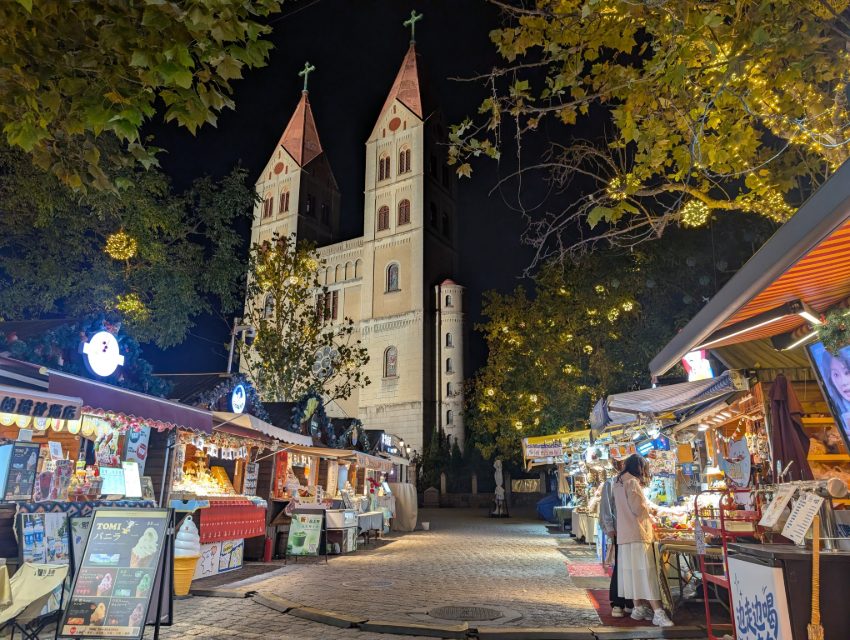

Having successfully ticked off my summer travel goals—a brisk trek around England and a targeted exploration of Vancouver Island—I naturally turned my attention to winter. I began with a return trip to China, though by the time the geography sorted itself out, I felt less like an intrepid Asian explorer and more like a confused Bavarian who’d taken a wrong turn at the Danube.
It all started with a little administrative hack I learned about last year: China’s 10-day transit visa. It is a curious bypass around the traditional consulate process, something that resembles a visit to the DMV, if the DMV office was located in a city 600 miles away. For the transit visa, you simply show up with a valid passport and an outbound flight leaving within ten days, and you’re free to move about the country.
There are, of course, a few caveats. You must depart for a country different from the one you arrived from, and the border agents are visibly comforted when you present a complete itinerary printed out on paper, preferably translated into characters only they can read. Upon arriving from South Korea, I handed them a stack of hotel and train reservations covering every single day, culminating neatly in an outbound ticket to Thailand.
Honestly, there are no surveillance mechanisms confirming that you are following your itinerary, so once you’re in, you can make all the changes you want, provided you are gone by midnight on day ten. In fact, you get a bonus day because the clock doesn’t start ticking until the stroke of midnight following your arrival.

Naturally, I had my true intentions in my head. I planned to take the train from Qingdao down to Xiamen, where a thirty-minute ferry drops you onto Kinmen—an island belonging to Taiwan. The irony is comical: Beijing perpetually hyperventilates over its sacred claim to Taiwan, yet Kinmen sits practically inside Xiamen’s harbor like a stubborn barnacle. China maintains this economic umbilical cord because proximity breeds dependency.
Since I had entered from South Korea, I could technically hop over to Kinmen at the end of my ten days, turn around on the next ferry, and re-enter China for another ten-day stint, provided my ultimate escape hatch pointed somewhere other than Taiwan. Play your cards right with Hong Kong and Macau, and you can theoretically bounce back and forth until the end of time. Whether I had the stamina to test that theory was another question entirely.
I chose South Korea as my gateway because it offers one of the shortest, cheapest hops across the Pacific and dumped me just one hour away from a Chinese city I had been itching to see: Qingdao.
Two things put Qingdao on my radar. First, when I asked AI for a city that captured the steep, dramatic topography of Hong Kong without the equally steep price tag, it suggested Qingdao. Second, every photograph made it look suspiciously like a nineteenth-century German spa town.

History buffs will recall that Germany, suffering from a severe case of imperial FOMO (Fear Of Missing Out) during the Opium Wars, decided it needed its own slice of the Asian pie. They leased Qingdao via aggressive gunboat diplomacy, promptly erected heavy European architecture, and introduced the local populace to the sacred art of brewing. Before it was Qingdao, it was Tsingtao—the very beer that now graces Chinese restaurants from Omaha to Osaka.
Today, beer remains the lifeblood of the local economy. Every single block features sidewalk tap dispensaries where locals fill bottles or, more impressively, clear plastic baggies secured at the top with a knot and pierced with a straw. Drinking lager out of a Ziploc bag while strolling down a Chinese street is an experience that instantly realigns your worldview.
Aside from the ubiquitousness of beer taps, what stopped me in my tracks was the skyline. Wandering Qingdao’s rolling, hilly streets, my brain struggled to remind itself I was in China, not Europe. The red-tiled, steeply pitched roofs wound down curved avenues in a way that looked less like Shandong province and more like an alpine village overlooking the Danube.

In the distance, jagged red peaks of sedimentary rock pierced the blue sky. I considered heading into the hills for a hike, but a bus ride along the coast revealed sweeping public beaches and a fascinating slice of modern history: Qingdao was the co-host city for the 2008 Beijing Summer Olympics. Because landlocked Beijing couldn’t accommodate deep-water ocean sports, Qingdao was selected to stage all the Olympic sailing events. Now styled as China’s Sailing Capital, the waterfront has been brilliantly repurposed into a sprawling pedestrian playground complete with giant Olympic rings, maritime museums, and breezy breakwaters.
By evening, I found myself sitting in a historic beer garden in the heart of the city, happily devouring a plate of Wiener Schnitzel. AI had not only delivered a Hong Kong alternative but a European alternative, with beer practically flowing out of the fire hydrants. My next stop was Suzhou, the self-proclaimed Venice of Asia.

How it landed on my itinerary, I cannot recall. Perhaps the AI sensed my deep-seated craving for canals. It did not disappoint. Suzhou is a labyrinth of water lanes, and while the traditional gondola ride is a bit of a tourist treadmill, strolling the stone pathways alongside the canals is a delight. I confess I took a boat tour, only to realize it followed the exact walking path I had just completed on foot.
The streets hum with food stalls, tea houses, and souvenir hawkers, bursting into a theatrical glow at night when hundreds of red lanterns reflect off the dark water. I managed to secure a hotel right off the pedestrian drag for thirty dollars a night and promptly extended my stay by twenty-four hours simply because I refused to leave.

As it turns out, Suzhou (pronounced SuJo) is just the marquee headliner in a vast network of water towns. Because of its massive train station, it draws the lion’s share of traditional costumed photo-shoot crowds. If you want to escape the lens-wielding masses, you head south to places like Tongli, Zhouzhuang, or Zhujiajiao.
Unlike many of today’s waterfront cities, which have traded rivers for roads, these ancient towns still treat water as the center of the community. Powered by muscle and wooden oars, the boats here remain mercifully immune to rising fuel costs. More importantly, water travel enforces a civilized velocity. A collision between two human-powered wooden skiffs results in nothing worse than a polite apology, unlike our modern obsession with hurling metal boxes through space at speeds only a housefly can comprehend.

Just as I enjoy cruising a river or walking a winding street in Europe, I experienced taking in China in the same way. The only surprise was that I was occasionally confused about which one I was in.
Whether I am cruising an European river, walking an English footpath, or drifting down a Chinese canal, the underlying joy is identical. The only real mystery is remembering, from one minute to the next, precisely which continent I am standing on.
Leave a Reply