

For the first time in four years, I led a tour of my own creation. That’s not completely accurate; My current boss has taken a few of my suggestions and turned them into tours that he’s assigned me to, but this was the first tour since my 2022 Morocco trip where I was responsible for everything: the research, the marketing, the budgeting, and the stress of wondering whether I would end up funding my clients’ vacation.
It reaffirmed two fundamental truths about my character. First, I love leading tours. Second, I am a mediocre businessman. After a year of meticulous planning, I managed to recruit a total of three people to join me in Mexico. It is a humbling experience to realize your marketing reach is roughly equivalent to a garage sale in a cul-de-sac.
However, one of those three was a guest who had traveled with me a decade ago on my “budget tours.” For this experience, he paid ten times the price of that tour. That was a strong vote of confidence, and while I wasn’t able to make it a lucrative excursion for myself, I was able to make it a lucrative experience for others, and that really is what I enjoy most.

Day 1: Of Pyramids and Prostitutes
While visiting Queretaro wasn’t in our original plan, it got added to the itinerary because of a couple of changes. Our guests arrived earlier than expected, and shuttling straight to the hotel in San Miguel de Allende would have put us at the front desk well before check-in. Additionally, the pyramid we had pitched for later in the week was embroiled in a property dispute—a common Mexican pastime.
Instead, we headed straight to downtown Queretaro for a history lesson with our guide, Alfredo, followed by a visit to the nearby Pyramid El Cerrito. As it turns out, El Cerrito is significantly larger than the other pyramid we had originally advertised. In travel, as in life, being denied one route often leads to access to an even better one.
After our historical walks, things got interesting. We headed to a brothel. When Joan and I had arrived a few days prior, our taxi driver gave me a look of profound concern when I gave the name of our accommodation, Casa de La Noche, which translates in Spanish to “whorehouse”. The cabbie looked at me, then at Joan, then back at me with a silent, “Are you sure, Señor?” We confirmed with him that Casa de la Noche was indeed the name of our hotel, a name that the current owner had chosen to reflect its more lucrative past. In fact the past was not too long ago. On the way back from Queretaro, Alfredo shared that his uncle had once been a satisfied customer of the establishment as recently as the mid-eighties.
The place is now more of a compound consisting of four buildings that occupy most of a block in San Miguel de Allende. The owner, Barbara, is a dynamic force, who at 81, runs the place with the energy of a 20 year old. She is an artist and designer who has a say in every detail of the place. On our tour of the premises, she showed us the former Madame’s room, where “providers” and “clients” once negotiated whether they would part separately or depart together.
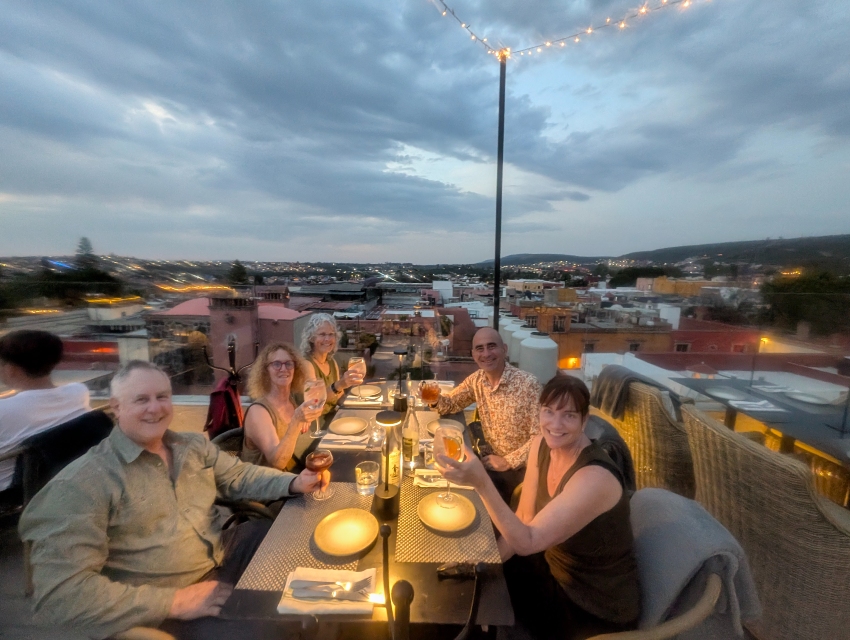
Casa de la Noche is located only a few blocks from the town center, and we walked to a nearby restaurant for our first group dinner. Those who’ve toured with me before know I like to begin boldly, typically from a rooftop perch overlooking our destination. Restaurante 1810 provided views of the main city church (La Parroquia) as well as a 360 degree view of the city. We timed our arrival perfectly to watch the sky change color above us and the setting sun cast its final glow on the Parroquia.

Day 2: Wine, Monks, and Bottle Bunkers
Alfredo arrived after breakfast and took us on a walking tour of San Miguel de Allende. We learned about the history of the town as well as his personal history as a child, meeting at “the rock” which is a large stone that juts out of a corner of a building because it was easier to leave it there than to remove it. He took us to the weekly organic market, held every Saturday. It was a chance to see the textiles, crafts and food produced by locals. No worries, even if you’re not there on a Saturday, you can still visit the Mercado Sano which carries a huge variety of local, organic food.
Despite all the local food offerings, I entreated people to wait for our wine experience. We started at Dos Bujos, a rustic place that has the atmosphere of tasting wine in Tuscany, and we learned how tasting wine in Mexico is different than in the US. Wine tasting in Mexico is not a “sip and spit” affair; it is a marathon. We ordered a picnic that could have fed the number of people I’d hoped to have had on the tour. Later we were led through the vineyards by a sommelier who poured tastings with the heavy hand of an Italian grandmother who never thinks you’ve had enough.
Not heeding our knowledge of only visiting one winery in a day, we headed off to Toyan next. If Dos Bujos is a rustic dream, Toyan is a fever dream. Surrounded by gargoyles atop columns overhead, you are greeted by a man dressed as a monk who leads you three stories beneath the earth into a bunker illuminated by an eerie blue light. The owner apparently decided that instead of refrigeration, he would simply dig a hole large enough to survive an apocalypse, provided you were happy to survive solely on casks of Cabernet. In the blue light, you can’t see the color of what you’re drinking, but at that point, the “experience” has thoroughly overtaken the “enology” in their subterranean tasting room.

Day 3: Water Births and Artist Works
We spent Day 3 soaking at La Gruta Hot Springs, a place historically used for women to give birth. I am happy to report there were no mid-pool deliveries, just water aerobics and Micheladas (Mexican beer mixed with spicy tomato juice). Everyone signed up for massages which was perfect after soaking in the thermal springs for a couple hours.
Later, we visited Fábrica La Aurora, a textile-factory-turned-art-gallery. There are over 45 galleries. One of the guests had forgotten to bring her wallet and asked if she could borrow some money just in case she saw something she wanted. I handed her a $50 bill, all I had, but warned she’d find nothing there she could buy for that price. She returned to me later saying she did find a shopping bag she could afford.
After looking at things we couldn’t afford, we walked over to the Mercado Ignacio Ramírez artisan market. This is similar to the Fábrica only it is locals selling their crafts where $50 could fill two shopping bags of merchandise.

Day 4: Art and Architecture
The day began with a Papier Mache workshop at a tallavera that has been in business over 3 generations. Quetzal, the current owner’s daughter, walked us through the workshop where they produce papier mache objects for people and places all over Mexico. One of the more interesting was a papier mache turtle that she explained was used for putting a loved one’s ashes in and then floating them out to sea. I couldn’t help but feel a pang of anxiety imagining that turtle being mistaken for one of the many piñatas they also produce. That birthday would be more traumatic than a funeral at sea.
We spent a couple hours learning how to press papier mache into molds and painting our own creations. I had been worried that it was going to seem a little juvenile but everyone seemed to love it, and it was a struggle to get them out of the workshop even though we had a long day ahead.
From the workshop we headed out to Atotonilco Gallery, which is a beautiful collection of crafts from native tribes throughout Mexico. It is wonderfully laid out with pictures of the artists next to their works and the names and locations of the tribes printed on the price tags. It’s a great opportunity to check out the diversity of artwork that has been developed and passed down for years.
We were fortunate that the owner was away and that our guide was a smooth talker, because it resulted in our getting inside the owner’s residence to see her personal collection. The things in her home were clearly the curated most unique picks and easily overshadowed anything we’d seen in the gallery. We felt it was a privilege to have laid our eyes on such unique works.

We also visited the church at Atotonilco, considered the Sistine Chapel of Mexico. Unusually, the intricate murals on the inside once covered the outside as well. Our guide explained how flummoxed he was that they had done nothing to protect the exterior works like planting a tree to prevent the years of Mexican sun from bleaching the images off the wall. Surely, he said, the people who painted such sophisticated materials must have understood the power of the elements, but nothing was left save the ghost of some of those images.
Humans still haven’t learned to respect the elements. Even we, who knew rain was predicted for that evening, chose to depart the hotel right as the deluge hit. We’d had plans to check out a particular restaurant, but those plans were dashed as the streets became rivers and we tucked into the first dry place with a menu.

Day 5: An oasis in the desert
Tuesday was originally scheduled to be a free day for our guests to explore San Miguel de Allende, but Barbara told us that the Botanical gardens offered free walking tours, so we decided to take the guests there. Who doesn’t like a botanical garden? Apparently everyone loved the guide, but I had decided I’d rather experience the place than have someone tell me about it so I headed off on my own for the two hours they walked.
For lunch we headed to Luna de Queso which is hidden outside of the main commercial area. It’s ironic because it offers some of the most healthy food in town. For dessert, we took everyone to City Market. If not for Gelato, for the eye candy of the most beautiful supermarket chain we’d ever been to. Finally we headed back to town so that everyone could enjoy some free time exploring or shopping since it was our last day in San Miguel.

Day 6: Kayaking across History
On day 6, we moved on to Guanajuato, starting with a kayak trip led by Andres and his son. We paddled across a reservoir to the skeletal remains of a 19th-century church. Before the reservoir had been built, the valley below it was occupied by a town at the confluence of three rivers. Since then, the town has been relocated higher up and a few miles away, and today those rivers do their best to keep the reservoir full, but it’s a challenge in the desert.
What had drawn me to this experience the year before was pictures of people kayaking through the arches of a church. Unfortunately, the water levels are rarely that high, and despite the heavy rains of the previous week, we still had to beach our kayaks and walk into the ruins. If anything, it made the experience feel like a scene from Raiders of the Lost Ark.
Our hotel in Guanajuato was a distinct contrast from the brothel in San Miguel. The Edelmira Hotel is a Boutique hotel. I chose it not so much for that reason as to the fact that when you stepped outside the hotel, you were in the middle of town. For dinner, we met with Tim Leffel, author of A Better Life for Half the Price. It was a chance for my guests to grill a man who had successfully figured out how to live the dream without the “monk in a bunker” lifestyle.

Day 7: Tunnels and Alleys
We began our day with a food and history walking tour. The tour company had been started by Tim, our speaking host from the previous evening. Frida, our energetic and informative guide, walked us through food markets, tunnels and hidden plazas throughout the city. We were grateful for the opportunity to work off at least some of the calories we consumed.
The rest of the afternoon was spent exploring on our own until we rejoined Alfredo and his wife for dinner. Since it was his wife’s birthday, we invited them to stay the two nights we were in Guanajuato. After giving them the day to themselves, we reunited for our farewell meal at the most famous Mexican restaurant downtown, Casa Valadez. We finished the evening, and our tour, with an evening stroll through the alleys of Guanajuato with street minstrels, known as Callenojedas. While we couldn’t understand much of what was said, the spirit of the event was infectious.

Was the tour a success? Well, nobody got mistaken for a piñata, and we all made it out of the bottle bunker. In my book, that’s a win. I may not be a tycoon of the travel industry, but as I watched my three guests soak in the music and the moonlight, I realized that making a “lucrative experience” for others is a much better way to spend a week than balancing a spreadsheet.