
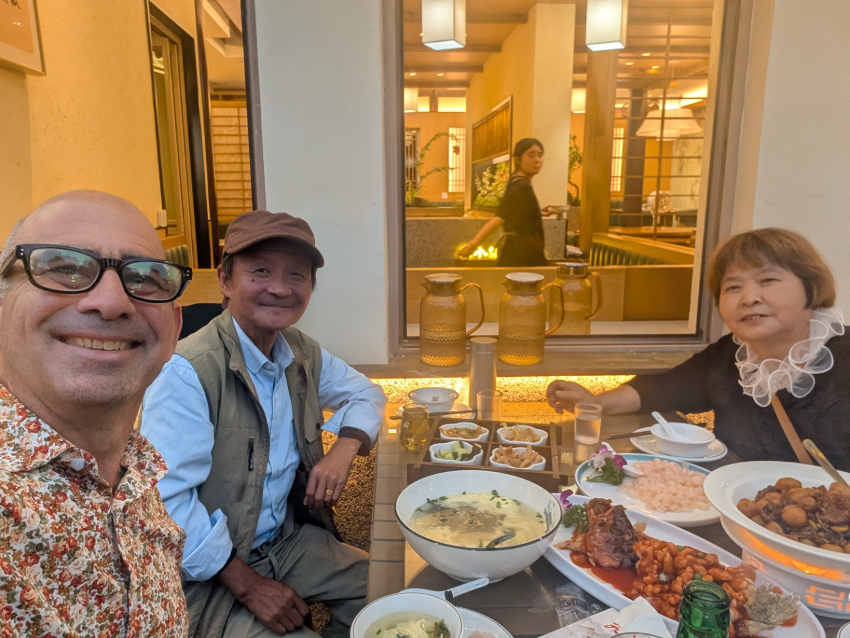

It is a classic travel paradox that never fails to amuse and humble us: the distance between the headline and the horizon.
When you sit at home thousands of miles away, your window to the world is largely framed by 24-hour news cycles, geopolitical posturing, and high-stakes diplomacy. News, by its very definition, relies on the exception rather than the rule. A peaceful afternoon sipping tea in a Suzhou teahouse or wandering through a bustling local market doesn’t generate clicks, ratings, or congressional hearings. Conflict, tension, and systemic differences do. Several distinct factors drive this wide gap between media perception and travel reality:
Modern media thrives on conflict and the “otherness” of foreign nations. Countries that are framed as geopolitical rivals or systemic competitors are rarely depicted through the mundane, beautiful rhythms of daily life—the grandmother exercising in the park, the neighborhood noodle chef perfecting his broth, or the sheer warmth of a stranger helping you navigate a subway station. When the lens is permanently zoomed in on high-level friction, it flattens a country of 1.4 billion complex human beings into a monolith.
Before visiting, many travelers unconsciously project their home country’s anxieties onto unfamiliar soil. You are told what to fear—surveillance, hostility, restrictions, or danger. But once you arrive, you experience the granular, everyday texture of life: people going to work, taking care of their kids, laughing with friends, and enjoying dinner. You realize that beneath different political structures and cultural norms, the fundamental human desire for community, safety, and a good meal remains entirely universal.
Travel is the ultimate antidote to abstraction. It strips away the second-hand narratives and replaces them with direct, sensory truth. Whether you are navigating the chaotic charm of a Mexican street market, exploring the ancient temples of Myanmar, or taking in the serene canals of Suzhou China, you discover that the “boogeyman” label is almost always a political construct, whereas the hospitality, food, and culture on the ground are delightfully human.
Mark Twain—who knew a thing or two about shaking off preconceived notions—famously wrote that travel is fatal to prejudice, bigotry, and narrow-mindedness. It turns out that reading the news from an armchair makes the world look dangerous and stark; stepping out onto the sidewalk makes it wonderfully, complexly alive. It is incredible how quickly the physical reality on the ground shatters the two-dimensional picture we are handed back home.
When you grow up with crumbling bridges and sluggish public transit in the States, stepping onto a high-speed train gliding smoothly at 220 miles per hour—while you sip hot tea and watch dramatic karst mountains or terraced rice paddies blur past the window—feels like stepping into the next century.
People forget that China spans roughly the same land area as the United States, but crams in nearly every climate zone and ecosystem known to humankind. You can go from the sub-tropical limestone pillars of Guilin and the bamboo forests of Sichuan to the otherworldly high-altitude salt flats of Qinghai, the windswept grasslands of Inner Mongolia, and the jagged glaciers of Yunnan. It is not just a country; it is an entire continent disguised as a single nation.
It takes a minute to wrap your head around the cashless, app-driven daily rhythm, but once you lean into it, the sheer efficiency is intoxicating. You realize you can breeze through an entire city, rent bikes, order street food, and hop subnets without ever touching a piece of paper currency.
In sharing my experiences of China’s breathtaking landscapes, hyper-efficient technology, and warm daily life, I inevitably trigger the “Yeah, but…” reflex. Readers will want to ensure I’m not turning a blind eye to the very real and serious issues surrounding civil liberties, government surveillance, and political control. ‘What about human rights? What about surveillance and freedom of speech?’
It’s a fair question, and one can’t—and shouldn’t—ignore. The concerns about government control, internet censorship, and a pervasive security apparatus are real. They shape the macro-level reality of life here, even if a foreign tourist sipping coffee in a Suzhou courtyard or riding a high-speed rail doesn’t personally feel the friction day-to-day.
But the conversation often gets trapped in a rigid, black-and-white binary. We are conditioned to believe that a society must either look exactly like Western liberal democracy or be a dystopian prison. The reality on the ground is far more complex.
Ironically, experiencing a system that prioritizes collective stability and ultra-efficiency over individual friction sometimes forces you to look back at home with a fresh, critical eye. Sitting in America right now, our own public square feels fractured to the point of exhaustion. Algorithms on Facebook and X amplify outrage, outrage turns into polarization, and everyone’s individual, unfiltered opinion is treated as immutable gospel. Sometimes, watching a society that values quiet harmony over loud, chaotic discourse makes you wonder: Is our brand of absolute, untamed “freedom of speech” always working out for us, or has it devolved into a race to the bottom of mutual hostility?
This isn’t to dismiss or excuse systemic governance issues; it’s to acknowledge that every society makes a different trade-off. The U.S. trades social cohesion and predictability for individual liberty and expression. China trades certain individual liberties for collective order, safety, and breathtaking national progress. Neither trade is without its heavy costs. But recognizing that complexity is what travel is all about: leaving behind the comfort of simple stereotypes to grapple with the messy, multifaceted truth of how the rest of the world actually lives.”
If someone built their entire understanding of America strictly through foreign news feeds—the international equivalent of the 24-hour doom-scroll—they would likely view the United States as a terrifying, surreal post-apocalyptic movie where nobody can step outside without body armor or filing for bankruptcy.
If foreign audiences tuned into the same sensationalist, high-drama reporting, they’d assume every American citizen goes to sleep with a gun under their pillow. Visitors would expect to dodge stray bullets while navigating homeless camps, convinced that stepping into a grocery store or a movie theater carries a 50/50 chance of survival.
To the outside world watching American healthcare and economic news, getting an infection or breaking a pinky toe seems like a fast track to selling your organs on the black market to pay off hospital bills. Foreigners would imagine a country where citizens work three jobs, sleep four hours, and live in constant, existential dread of an ambulance ride costing more than a luxury sedan.
A foreign viewer would be convinced that America is on the brink of an immediate, apocalyptic civil war. They’d imagine a nation entirely divided into two armed camps, screaming at each other over Thanksgiving dinners, burning down neighborly fences over political lawn signs, and incapable of having a conversation without somebody being canceled, sued, or tear-gassed.
While American foreign policy projects an image of hyper-tech dominance, international news about failing power grids, derailed trains, pothole-pitted highways, and century-old subway tunnels would make foreign travelers expect a country whose physical foundation is slowly rusting into the Atlantic and Pacific oceans.
And yet, if a foreign tourist actually lands in Chicago, Savannah, or a small town in Vermont, what do they actually find?
They find people offering to help them carry their luggage up train stairs. They find warm, chatty cashiers who genuinely want to know how their day is going. They find sprawling national parks of unbelievable beauty, vibrant local music scenes, endless culinary diversity, and a culture of casual friendliness where total strangers will happily strike up a 20-minute conversation at a bus stop.
It turns out that just like China or Mexico, America’s greatest secret is its daily human reality—a reality that media cameras almost completely step over to get to the fire around the corner. It makes you realize that every country in the world is suffering from the exact same condition: perception over experience.
Leave a Reply