
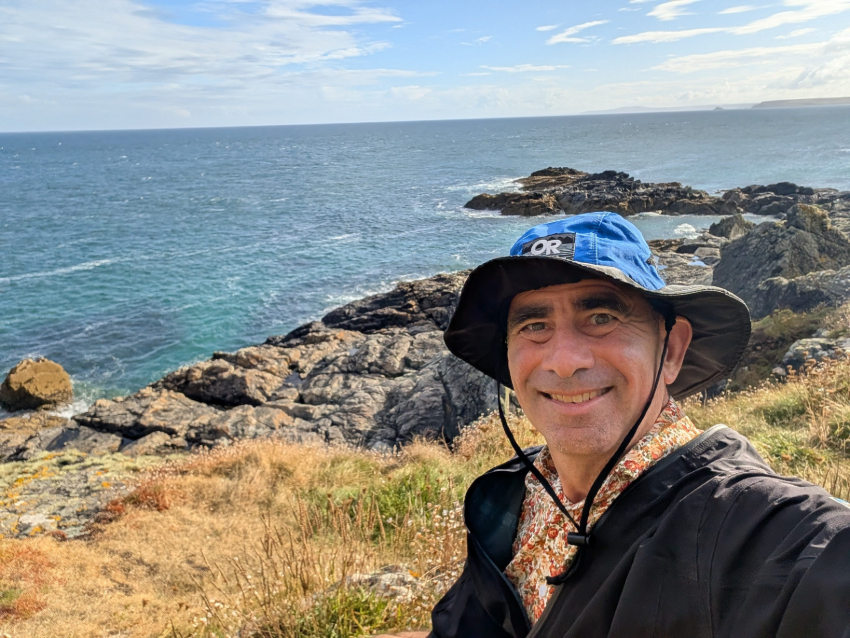

The primary incentive for my visit to England this summer between tours was to try hiking some of the historic pilgrimage trails I’d read so much about. I was thoroughly seduced by the romantic notion of ambling from village to idyllic village, popping into a cozy pub whenever I fancied a pint and a rest. I ran into two small problems, however. First, I didn’t actually want to haul all my belongings with me on the trail. Second, England turned out to be vastly bigger than I had calculated.
Because I was traveling with full tour-leading gear on top of my personal luggage, I had switched to a roller bag—an implement fundamentally incompatible with muddy footpaths and stile-hopping. I had read about door-to-door luggage transfer services for hikers, but that required booking every single stop in advance and shelling out an extra $30 a day.
I was already second-guessing my plan to simply wing it, unsure if one could just waltz into a tiny Cornish village and expect an open room. That uncertainty curdled into mild panic when I realized my week coincided with a British Bank Holiday. In England, a bank holiday is equivalent to Memorial Day weekend in the States: the entire populace simultaneously goes on holiday, not just bankers and government workers. The prospect of paying extortionate rates for the last remaining broom closet left me reconsidering everything.

Then came the geographic math. Operating under the comfortable illusion that England is small enough to cross in an afternoon, I figured I could easily circumnavigate its southwestern peninsula in the week I had. As it turns out, the South West Coast Path stretches roughly 630 miles. To complete it in seven days meant averaging 90 miles a day—a brisk, military-grade march that my body respectfully declined.
Once I recognized my folly, I pivoted. I decided to focus on two coastal towns as basecamps and venture out from there. Given bank holiday room rates, I narrowed my choices down to the only two towns with available hostel beds. (A third hostel was charging $215 a night for a single bunk, a figure I felt violated the basic definition of a hostel.) I landed on St. Ives and Newquay—both perched on the dramatic coast with immediate trail access.
I arrived in St. Ives by train after two transfers off the main line. The final spur hugging the coast was stunning, offering panoramic views of the Celtic Sea and the trails I had naively planned to conquer. To my surprise, the air was thick, hot, and humid, which explained the sea of sunbathers packed onto the sands directly below the station.

St. Ives was in full resort mode. Narrow medieval streets squeezed between two-story stone cottages forced pedestrians to spill into the road. Vehicle traffic was reduced to a glacial crawl, eliminating any real danger of being run over. After checking into the hostel, I threw on shorts and flip-flops to survey the harbor. Before long, I accidentally wandered onto the coastal path itself, turning back quickly so as not to spoil the proper hike I had scheduled for later.
I knew I wanted to visit Penzance and the nearby St Michael’s mount, the English version of Mount St. Michelle, a French castle marooned off the coast and accessible by land only at low tide. Having heard several people talk of huge delays in the bus services to get there, I wondered if it might be worth making that my first walk.
A historic pilgrimage trail ran directly from St. Ives to St. Michael’s Mount: eight miles, projected at roughly three hours. With low tide scheduled for 11:45 AM to expose the granite causeway, an 8:00 AM departure seemed ideal.

Trekking across the countryside was classic England. The path led through sunlit fields, over wooden ladders, called stiles, bridging stone walls, and under natural arches formed by overgrown hedgerows. I was fascinated by Britain’s network of public footpaths—over 140,000 miles of protected rights-of-way. The tradition dates back to feudal times when tenant farmers needed access to communal resources across the local lord’s estate. Today, law protects your right to hike directly through private farms and estates.
Navigation required constant attention; at times, the official trail leads literally down someone’s private gravel driveway. Because these paths cut through active pastures, barriers had to be devised to allow humans in but keep animals from getting out. I encountered a full menu of them: simple latching gates, wooden stiles, and “squeeze” stiles—V-shaped wooden openings narrow at the bottom and wider at the top. They required a bit of bodily agility on my part, making them an effective deterrent for livestock.
Unfortunately, the final third of the route transitioned to asphalt, and my legs began to protest. Right on cue, the fairytale silhouette of St. Michael’s Mount popped above the horizon, accompanied immediately by hordes of tourists. The queue of cars crawling toward the parking areas was staggering; I was profoundly grateful to have traversed on foot.

I strolled across the newly exposed stone causeway to the island but opted against buying a ticket to climb the castle summit. Spending $30 to walk up a hill after I had just trekked eight miles over a mountain for free seemed absurd. I preferred to spend that money on a proper lunch. Besides, I was anxious to get out of there before the crowds, that had thronged towards the island once the tide was low enough, decided to recede before it came back in.
Back in St. Ives, I squeezed in a nap before a booked session at Kiln, a local spa offering outdoor saunas and ice plunges on a cliff edge overlooking the ocean. Immersing myself in a tub of ice cold water was precisely the remedy my aching joints needed after an impulse eight-mile cross-country hike.

The next day, I tackled the coastal trail heading west from town. The weather was idyllic: bright sun, warm air, and a gentle ocean breeze. Watching the Atlantic swell crash against jagged granite cliffs, I began to re-frame my philosophy of “slow travel.” Wouldn’t I more accurately be following the practice by sitting on a rock and staring at the ocean for three hours? My brain posed the philosophical question; my sore leg muscles voted unanimously in favor.
Before catching my train to Newquay the following morning, I explored the quiet harbor at dawn. Walking the stone pier with a fresh coffee offered a magnificent view of St. Ives waking up. (I confirmed, incidentally, that the famous skincare brand shares no actual connection to the Cornish town, though the coastal charm would certainly suit the label.)
Newquay was an immediate culture shock. If St. Ives is where couples go to consummate their marriages, Newquay is where they bring those same children five years later for a different kind of endurance. The town was flooded with families dragging wagons full of buckets and shovels, dodging sudden downpours by ducking into the abundant amusement arcades. I felt a pang of sympathy for parents who had spent small fortunes only to be confronted by relentless rain and children pent up from being trapped in “cozy” holiday accommodations.

I retreated from the noise by hiking out to the rocky headland pointing west into the Atlantic. The coastal wind was ferocious, tossing giant waves against the cliffs with a thunderous boom. Despite the chaos back in town, I had the entire windswept headland to myself.
The region’s tides are staggering. Because incoming waters are funneled directly into the Bristol Channel, vertical tidal shifts can reach 26 feet. Combined with Newquay’s flat, gently sloping beaches, the waterline recedes up to 270 yards. That’s almost the distance of 3 football fields you have to walk if you want to get from your beach towel to the ocean, or you can just wait a few hours and the sea will come to you.
My final hike took me south toward a coastal river estuary. Rumor had it you could cross at high tide via a small foot ferry, or at low tide via an exposed boardwalk. High tide hit around 7:00 AM, but the ferry didn’t run until 10:00 AM—by which time the water would be gone anyway. Unwilling to waste three hours, I hopped a local bus as far south as I thought was comfortable walking back.

Dropping into a quiet, service-free hamlet, I followed a rural path that wound down toward the sea, offering sweeping views of rolling green hills. I took off my sandals to feel the damp, spongy turf underfoot, sharing the trail with grazing sheep. In places, the path hugged the crumbling cliff edge so tightly I quickened my pace, well aware of the fresh rockslides resting on the beach below.
Again I had the trail to myself and I took my time appreciating every perspective as the trail went around the head and came back into a hidden beach, accessible only by foot. That didn’t deter three surfers who’d obviously carried their boards with them from somewhere and were now paddling feverishly to position themselves for the perfect break.
The path dipped down to the beach, and I crossed the sand before climbing back up to the next head. When this one curved back to shore, I saw the river that the ferry was to cross. I guess I should say river valley as now the tide was completely out and one could easily cross from shore to shore on the riverbed. When I got to the ferry landing there was a sign stating that the ferry was not in service today, and my decision to take the bus earlier was validated.

By 2:00 PM I was back at the hostel, where my bunk mate was just stirring after rolling in at 4:00 AM. Marveling at the sheer volume of landscape I’d covered while he slept, I decided he had the right idea and promptly took an afternoon nap.
Six days after leaving my pet sit in Bristol, I boarded the train back to London to prepare for my flight to Denver for my next tour assignment. I had successfully maneuvered a roller bag, outsmarted a bank holiday, and trekked some of England’s finest coastal paths. And though I had a great feeling of accomplishment, I had a feeling it was more a precursor of adventures to come.