

We wrapped up our San Miguel tour, and the group scattered like a basket of spilled kittens. Two guests headed back to Portland, another struck out solo to Mexico City, and Joan headed back to San Miguel for a two-month stint. Me? I headed toward Puerto Vallarta to chase a ten-year-old itinerary.
A decade ago, when I was working at a hostel in Puerto Vallarta, my boss recommended I visit San Sebastián del Oeste, a town tucked high into the Sierra Madre Occidental mountains. To get there required braving a legendary, two-hour winding bus ride into the clouds. Over the years, I’d stared at maps mentally daisy chaining these mountain outposts together, essentially tracing the original historic road between Puerto Vallarta and Guadalajara. I’d meant to do it two months ago after our Villa tour, but a rent-free three-week house sit in Mexico City sidelined me—and frankly, it’s hard to say no to free rent in a megalopolis. In hindsight, the delay was a blessing; the week before I originally intended to go, a major cartel leader was killed in one of the towns on my route. But now, with the San Miguel tour behind me, the timing was perfect to run the route in reverse.

I had treated myself to an ETN ticket—the absolute gold standard of Mexican bus travel, effectively first class on wheels, but my self-gifted life of luxury ended before it began. I was sitting in the dedicated premium client lounge, when a station agent walked in, rattled off an announcement, and vanished. I asked the man next to me to translate what was said as I didn’t understand one of the words she had used, and it seemed to be the lynchpin of the whole delivery. The mystery word was: breakdown.
Timing wasn’t critical, but I had a mountain to catch. The luxury line’s replacement bus was a vague three hours away, so after waiting forty-five minutes for another update, I took a refund and downgraded to Primera Plus. It’s a perfectly fine line, but dropping from first class to a completely full “premium economy” bus decisively undermined my illusions of a spa day on wheels.
We rolled into Guadalajara’s shiny New Terminal an hour and a half late, effectively killing my chances of making it up the mountain before dark. Worse yet, the sleek modern terminal didn’t service the remote, high-altitude towns I was targeting. For that, I had to catch local transit across the city to the Antigua Central—the old station—which looks and feels like it’s in a Mexico 70 years in the past.

Discovering that all buses up the mountain had ceased for the night, I made a tactical decision: catch a local bus halfway to get a head start for the morning. The driver was a master of urban escape, navigating our passenger bus through narrow residential neighborhoods that didn’t seem designed as a transit route. He successfully bypassed the Friday evening exodus traffic, though the bus slowly packed to maximum capacity with commuters, and we arrived in Ameca an hour late due to rush hour.
I immediately found the ticket counter, where a woman promised the first morning bus departed at 8:00 AM. Strolling into town, I passed a seemingly out-of-place sushi restaurant and began hunting for a bed. Online hotel rates were shockingly high for a farming town, so I decided to gamble on old-fashioned footwork. The first hotel on my map looked decidedly transactional—the sort of place rented by the hour—so I pivoted to a spot with better online reviews, harboring a mild anxiety that Friday night revelers might have snapped up all the rooms.
Fortunately, they had space. It was an aggressively simple room: a bed, a fan, and a bathroom. There was no air conditioning, but the mountain air meant the fan was plenty. At first I thought there was no shower, but after looking up, I saw a shower head protruding randomly above the toilet. It dawned on me that it was one of those bathrooms where the shower sprays all over the bathroom, entirely unencumbered by a curtain or stall, meaning a shower effectively washes the entire room simultaneously. I’ve always appreciated the efficiency of being able to clean the bathroom while showering.

Dehydrated from a day of strictly rationing my fluids—a mandatory survival tactic when you face uncertain transfer times and buses that may not have restrooms—I returned to the sushi place for a bowl of soup. Ameca itself felt exactly like a small American farming town, just transplanted into Mexico. It featured the mandatory large central square and a band shell, but it lacked the grand, sweeping architecture of the colonial tourist hubs. It was an honest, working town, where the locals flocked to the plaza simply to celebrate the cool air after the sun went down.
I woke at my usual 4:00 AM to a chilly room, a lack of a way to heat water for tea, and the discovery that the 24-hour OXXO across the street was, in fact, closed. The pre-dawn silence was punctuated by a rhythmic, mechanical din from down the road that sounded suspiciously like a slaughterhouse—though whether it was the call to a shift or the actual processing of livestock, I couldn’t be sure. By 6:30 AM, tired of killing time, I walked over to the bus station. It would have been a tragedy to miss the first bus just because I was loitering in my austere room.
The bus rolled in from Guadalajara right on time at 8:00 AM. I was incredibly glad I’d stayed the night in Ameca; otherwise, I’d have been boarding this same bus at 6:00 AM in the city. I had spent my time at the bus station calculating which side of the vehicle would offer the superior view, but the point became moot when the bus arrived nearly full. I snatched an empty seat on the right side—which did turn out to be the scenic winner—but my luck quickly vaporized when I realized the reason it had been vacant. I was trapped directly in front of a couple who proceeded to argue about politics for the entire journey.
It turns out that political arguments are exactly the same brand of annoyance in every language. Even with my limited Spanish, the cadence was instantly recognizable: both talking heatedly, neither listening. The scenery outside was spectacular, a sweeping canvas of rising peaks and deep valleys, and all I could think was how badly I wanted to turn around and inform them that their conversation was having a far more negative impact on my day than any government policy. I eventually moved seats at the first opportunity with a nod of silent understanding from the other passengers.

Halfway up the mountains, we barreled through a small mountain village where the main street was lined with local women vigorously waving cardboard signs, entreating the bus to stop and unload hungry passengers at their respective diners. Our driver was moved more by schedule than circumstance and blew right past them; though I watched two tourist coaches ahead of us quickly capitulate to the roadside marketing, knowing that comped meals always awaited the drivers.
Finally, the road dropped into a wide, high-altitude valley surrounding the famous religious pilgrimage town of Talpa de Allende.
The pilgrimage here is legendary, drawing millions of faithful who trek over 100 kilometers across rugged Sierra Madre passes to pay homage to La Chaparrita (Our Lady of the Rosary), a tiny cornstalk Virgin statue famed for a miraculous spontaneous restoration back in 1644.

Despite the town’s lofty elevation, it sits in the middle of a remarkably dry, desert-like basin. The bus terminal itself was a thoroughly utilitatian building, and observing the arid surroundings convinced me that a cursory visit would be enough. I immediately bought my outbound ticket to Mascota. The sheer volume of passengers sprinting from the bus straight to the ticket counter gave me a jolt of anxiety; it was clear these mountain routes sell out fast, even on a regular weekend.
When I asked the station agent if I could store my luggage inside her office, she gave an indifferent nod and pointed to a bare spot on the floor outside her door. Hoping for the best, I left my bag and walked into the town center. Ninety minutes proved to be the perfect amount of time required for Talpa de Allende. I took a few photos to prove I’d made the pilgrimage, grabbed my bag, and boarded the next bus out of town.
When the bus dropped me in Mascota, the town felt completely deserted, evoking the stillness of a Greek village in the dead of mid-afternoon heat. The only immediate sensory input was the pervasive, unmistakable odor of tripe being cleaned somewhere in the immediate vicinity.

Mascota’s claim to fame is the Templo Inconcluso de la Preciosa Sangre (The Unfinished Temple of the Precious Blood). Calling it a ruin isn’t technically accurate; it’s simply a massive, neo-Gothic masterpiece that never received a roof. Construction began in the late 19th century but ground to a halt when the Mexican Revolution erupted in 1910, followed by the Cristero War. Today, it’s a beautiful, open-air cultural space where lush green lawn carpets the interior floor and vibrant bougainvillea frames the towering stone archways. Unlike the church in Talpa de Allende, it is more frequently used for photography than any pilgrimage.
Unfortunately, the unfinished state of the church seemed to be a metaphor for the rest of the town, which felt like it was actively unraveling. I stood on a corner and watched as a woman carrying an umbrella braced her hand against a parked car to carefully navigate a pile of loose rocks masquerading as a curb, while a young boy rode monotonous circles in the dusty roadbed. On my way to the town square, I passed a man tenderly massaging his rooster’s wings, like a corner-man prepping a prize fighter before a bout.
The main plaza was so devoid of life and energy that I managed to walk completely through it twice before realizing I hadn’t even bothered to take a photo. I found it baffling that a town with several high-end boutique hotels could simultaneously possess almost no visible restaurants. While I’m certain the town square wakes up once the heat of the day wanes, I didn’t want to invest another loop of my life looking for it. Since darkness was approaching, I relented and booked a room. In hindsight, I should have skipped Mascota entirely, but that’s the price you pay for trusting online travel blogs.

The next morning, I headed to the bus stop and was handed a hand-written, assigned seat ticket. I spent a few minutes marveling at the logistics: this bus originated in an entirely different town, the agent had no computer system, yet she somehow knew which seats were available.
I’d taken a Dramamine before the ascent from Ameca, but since the roads were well-paved and the drivers were surprisingly conservative around the curves, I skipped it for this leg. Unfortunately, the child behind me was very sensitive to the motion and spent the time vomiting into a plastic bag held in front of him by his mother.
There is no direct bus to San Sebastián del Oeste. The mainline coach drops you at a mountain junction called La Estancia. From there, you rely on local transport to conquer the final eleven miles up the mountain. There may have been an occasional local bus, but it didn’t seem like service would be frequent based on the size of the town. A small fleet of local taxis waited at the junction, and since the ride to the top was a mere five dollars, I happily embraced the convenience.
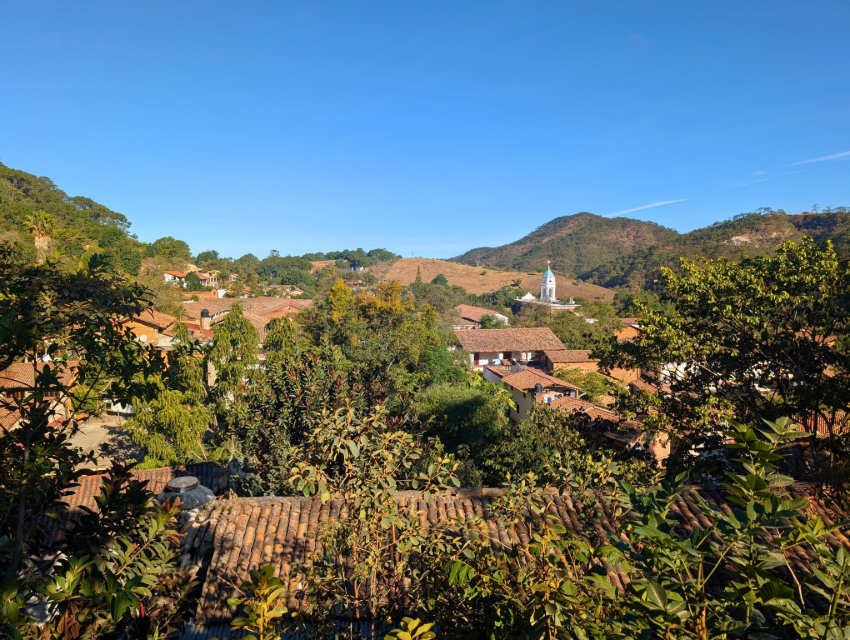
I rolled into San Sebastián around 10:00 AM, found a local cafe, ordered a coffee, and considered lodging options while taking in the views of the charming down below me. I ended up chatting with a local policeman who told me how much he loved working a small-town beat where literally everyone knows each other—and are likely related. The cafe owner turned out to be the son of a long-time local cigar maker. Apparently, this mountain enclave once had a bustling historic identity centered around tobacco farming and hand-rolled cigars alongside its silver mining roots.

The owner kindly offered a room at his aunt’s place to stay, but it turned out to be halfway back down the mountain road I’d just paid a taxi to climb. I struck out on foot to scout properties, a stark reminder of why I usually don’t travel without reservations—spending precious hours of a short two-day visit hunting for a bed is a terrible use of time.
During my search, I met a wonderfully polite hotel proprietor named Jorge, who spoke Spanish at a beautifully metered, deliberately slow speed. He chuckled and explained that because they get many tourists, he’s well-practiced in accommodating foreigners trying to piece the language together. I loved his property, but the only available room was a windowless, cave-like bunker in the back.
Instead, I found a homestay that felt more like a hostel—wide open, featuring a spectacular back patio that looked directly out over the jagged peaks of the Sierra Madre. It cost a couple of dollars more than Jorge’s cave, but I gladly paid the premium for the view.

Walking back into the town center, I smiled. Mexico’s Pueblos Mágicos (Magical Towns) designation can be wildly inconsistent—the last two destinations on my itinerary proved that—but San Sebastián absolutely hits the mark. It boasts sweeping alpine vistas, the rich scent of mountain pine, and cobblestone streets that feel more like hiking trails. A quiet lunch by an ancient stone bridge and a walk past the historic cemetery felt like a stroll through Tuscany. Ten years late, I had finally made it to the town from the hostel story—and it’s officially going on my list of personal favorites.